Wickenburg, Arizona: A History
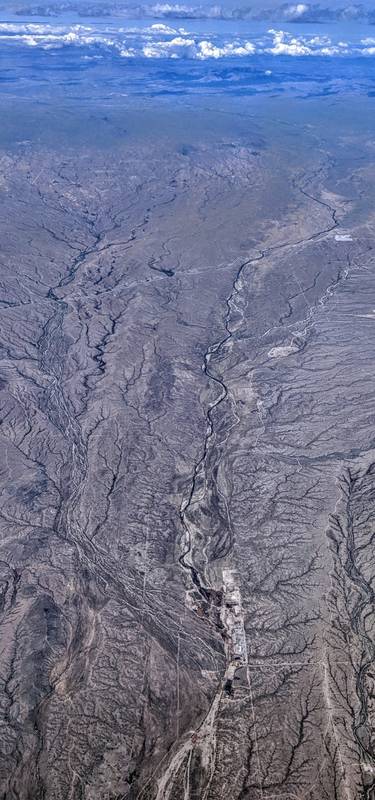
Gold, Floods, Outlaws and Dude Ranches on the Hassayampa, 1863 to the Present
Contents
- Gold, Floods, Outlaws and Dude Ranches on the Hassayampa, 1863 to the Present
- At a Glance
- Timeline
- Part I: Founding, Gold and the Territorial Town (to 1900)
- Part II: Crime, Violence and Death
- Part III: Disasters and Big Events
- Part IV: The Modern Town (1900–Present)
- Part V: Legends and Conflicts, Quick Reference
- Research Gaps
- Principal Sources
A Before the Blueprint research report, October 2026. Every claim below is traced to a cited source. Throughout this report, Legend marks a story that is popular but undocumented, and Conflict marks a fact on which sources disagree.
.jpg)
At a Glance
| Founded | Oct–Nov 1863 (Vulture claim signed Nov 24, 1863) |
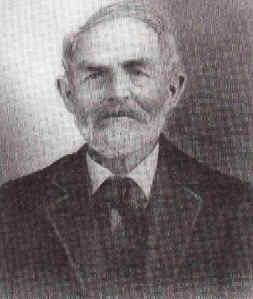
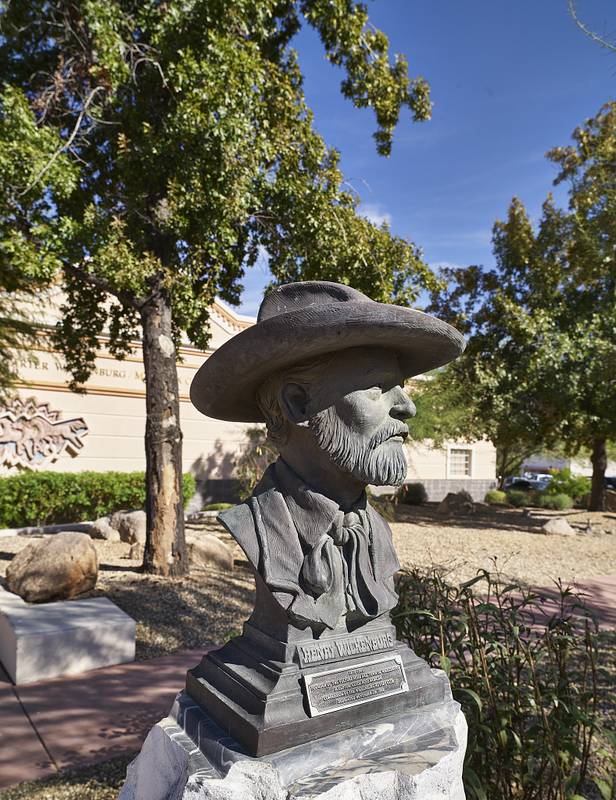
| Named for | Henry Wickenburg (bapt. Johannes Henricus Wickenburg, Essen, Prussia, b. Nov 21, 1819, d. May 14, 1905) |
| Townsite platted | Sept 23, 1898 (an 1868 plat was never filed) |
| Incorporated | 1909: vote Apr 24; the town gives June 19, the 1986 NRHP nomination gives Dec 25 (Conflict) |
| Railroad | Santa Fe, Prescott & Phoenix rails arrived Dec 1894; depot 1895; last passenger train May 1969 |
| County | Yavapai until Feb 14, 1871; Maricopa since then (the town limits now reach north into Yavapai) |
| Population | 174 (1870) · 104 (1880) · 570 (1910) · 995 (1940) · 2,698 (1970) · 5,082 (2000) · 7,474 (2020) · est. 8,305 (2025) |
| Nicknames | "Dude Ranch Capital of the World," "Team Roping Capital of the World," "Out Wickenburg Way" |
| Worst disaster | Walnut Grove Dam failure, Feb 22, 1890, which killed roughly 50 to more than 100 people |
| Most famous crime | The Wickenburg Massacre stage ambush, Nov 5, 1871, which killed 6 (7 with a later death); officially unsolved |
| Gold produced (Vulture Mine) | About 340,000 oz gold and 260,000 oz silver, 1863–1942 |
Timeline
| Date | Event |
|---|---|
| Centuries before 1863 | Western Yavapai (Tolkepaya) farm corn, beans, squash and tobacco along the Hassayampa |
| 1583–1605 | Spanish expeditions (Espejo, Farfán, Oñate) meet the Yavapai, whom they call the "Cruzados"; Spain and Mexico never govern this far north |
| 1848 | The Treaty of Guadalupe Hidalgo makes the region U.S. territory |
| Feb 24, 1863 | Arizona Territory created |
| Oct 1863 | Henry Wickenburg, E.A. Van Bibber and Theodore Green camp at the Yavapai "Pumpkin Patch"; Wickenburg spots a quartz ledge 14 miles west |
| Nov 24, 1863 | Vulture Lode claim signed |
| Spring 1864 | First arrastra; James A. Moore's letters coin the name "Wickenburg's Ranch" |
| Feb 1865 | 30 or more arrastras along 7 miles of river |
| 1865–66 | Wickenburg sells four-fifths of the Vulture to Benjamin Phelps of New York and is never fully paid |
| 1867 | Malaria epidemic; the Swilling Irrigation Canal Co. is organized in Wickenburg, and its ditch begins Phoenix |
| 1868 | Vulture produces $254,110 in less than a year |
| 1870 | Census: 174; "Vulture City" mill settlement named |
| Nov 5, 1871 | Wickenburg Massacre |
| Mar 1873 | "Second massacre": Swain, McDonald and Taylor killed on the Hassayampa |
| 1873–75 | Panic; Vulture closes and is sold at a sheriff's tax sale; the town is "a wreck of its former self" |
| Apr 20, 1875 | Merchant Heyman Mannasse shot dead in his store |
| 1878 | Jack Swilling arrested for a stage robbery near Wickenburg; dies in the Yuma jail |
| 1879–80 | Central Arizona Mining Co.: 80-stamp mill at the mine and a 14.5-mile pipeline from the river; Vulture City and Seymour boom |
| 1883 | "A relic of the past, with 100 houses standing empty" |
| 1886 | Martin family massacre (July); Charles P. Stanton assassinated (Nov) |
| Mar 1888 | Vulture superintendent Cyrus Gribble and two guards murdered for a gold bar |
| Feb 22, 1890 | Walnut Grove Dam failure |
| Dec 1894 | Railroad arrives; depot 1895 |
| Sept 23, 1898 | Townsite plat recorded |
| Jan 1899 | Constable Henry Wilson kills miner James Davenport |
| 1901 | Oro Grande boom; first newspaper, the News-Herald |
| May 14, 1905 | Henry Wickenburg found shot; ruled suicide |
| 1905–06 | Hotel Vernetta (Elizabeth Smith); Garcia School; Brayton Commercial Co. |
| 1909 | Incorporation; first mayor Henry Cowell |
| 1913–1929 | Garden of Allah, Kay El Bar, Remuda, Bar FX and other guest ranches open |
| 1921–1924 | Three fatal railroad wrecks (5, 4 and 1 killed) |
| 1926 | First hospital |
| 1927 | Vulture reopens |
| 1929 | Downtown fire destroys half a business block |
| 1937 | Hassayampa River Bridge and Center Street underpass |
| 1942 | WWII glider school opens; War Production Board order L-208 closes the gold mines |
| Feb 7, 1945 | Night watchman Clarence Dotson killed, the town police department's only line-of-duty death |
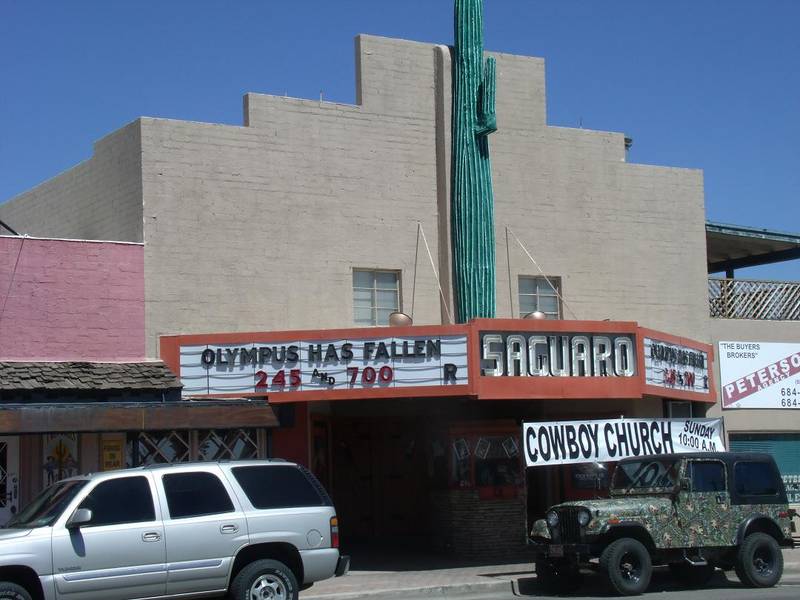
| 1948 | Gold Rush Days begins; Rancho de los Caballeros; Saguaro Theatre |
| 1950s–60s | Up to 14 guest ranches |
| May 1969 | Last passenger train (the "Hassayampa Flyer") |
| Sept 5, 1970 | Hassayampa flood of record (58,000 cfs) |
| Dec 21, 1972 | Desert Caballeros Western Museum burns |
| 1975–76 | The Meadows treatment center founded |
| July 10, 1986 | About 20 buildings listed on the National Register |
| 1990 | Remuda Ranch eating-disorder center opens |
| 2009–10 | US 93 bypass |
| June 12, 2024 | Rose Fire burns 7 homes |
| Oct 2025 | Museum renamed the Sigler Western Museum after a $20 million gift |
| 2026 | Wickenburg Community Hospital's centennial |
Part I: Founding, Gold and the Territorial Town (to 1900)
1. The river and its first people
The Hassayampa runs about 113 miles from the Bradshaw Mountains south of Prescott to the Gila River, mostly underground. Near Wickenburg it surfaces as a cottonwood-and-willow oasis. For centuries the Western Yavapai (Tolkepaya) farmed its banks, with the Kwevkepaya to the east. They grew corn, beans, squash and tobacco. Spanish expeditions under Espejo (1583), Farfán (1598) and Oñate (1604–05) met them and called them "Cruzados," apparently for crosses worn on the head. Neither Spain nor Mexico ever governed this far north, and the region passed to the United States in 1848.
The name the settlers gave Henry Wickenburg's 1863 campsite, the "Pumpkin Patch," shows that the town sits on a Yavapai farm. Newspapers of the 1860s and 1870s usually called the Yavapai "Apaches" or "Apache-Mohaves." The decade after 1863 brought raids and reprisals on both sides; by 1869 an estimated 1,000 Yavapai and 400 settlers had died in the region (Pry, 1997). The conflict ended with confinement at Camp Date Creek and Camp Verde. Then came the forced march of February–March 1875, when about 1,400 Yavapai and Tonto Apache were driven to San Carlos and many died on the way.
The river's name. Yavapai forms are recorded as Hasaya:mvo and 'Hasayamcho:. The Chamber renders it "Haseyamo," "following the water as far as it goes." The popular glosses "upside-down river" and "the river that hides" have no linguistic support. The town's best-loved legend says that whoever drinks from the Hassayampa can never tell the truth again, which is why a teller of tall tales is a "Hassayamper." The story goes back at least to the gold-rush era and is quoted in a 1917 poem and the 1940 WPA guide. In October 1909 a Prescott official handed President Taft a cup of Hassayampa water; Taft joked that he must have filled his canteen from the wrong part of the river.
2. Henry Wickenburg and the Vulture
The man. Henry Wickenburg was baptized Johannes Henricus Wickenburg at St. Johannes Church in Essen, Prussia, two days after his birth on November 21, 1819. Old magazine accounts that call him "Austrian" or date his birth to 1830 are wrong. Family tradition says he and his brother secretly mined coal on their own farm, where the state claimed the mineral rights. After a raid they fled; the brother vanished. Henry reached New York in 1847, worked as a fireman on the Pacific Mail steamer Cortez, and reached San Francisco in 1852–53. He came to Arizona in 1862 and joined the 1863 Peeples–Weaver party, which struck gold at Rich Hill.
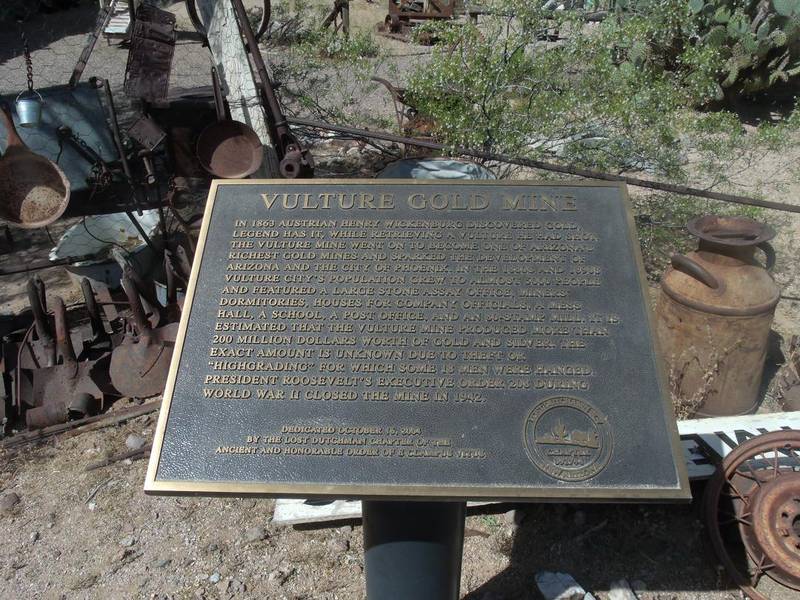
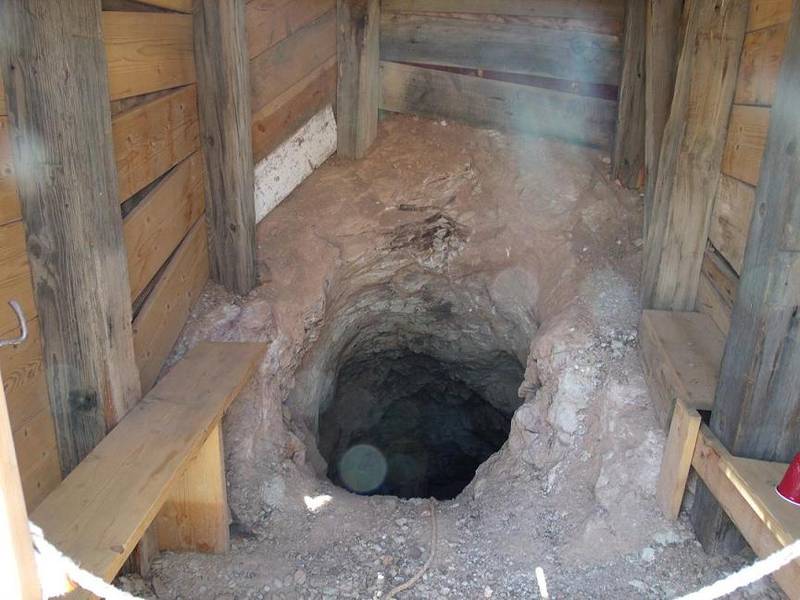
The discovery. In October 1863 Wickenburg, E.A. Van Bibber and Theodore Green (alias Rusk) set out from Peeples Valley for the Harquahala Mountains. They were looking for a rich ledge that Col. King Woolsey had described. They made a base camp on the Hassayampa at the Pumpkin Patch. On the trek, about 14 miles west of camp, Wickenburg noticed a quartz outcrop that his partners dismissed. He went back alone, liked what he found, and on November 24, 1863 a claim for the Vulture Lode was signed by A. Van Bibber, J.B. Green, W. Smith, H. Wickenburg and N.K. Estil. He then spent the winter alone at the mine, sleeping in the brush and moving camp every night for fear of attack.
Legend: How the Vulture got its name. Three stories have hardened into folklore. In the first, Wickenburg threw a rock at his runaway burro (named "Jenny" in a 1944 retelling) and the rock split open to show gold. In the second, he shot a vulture and found gold where it fell. In the third, vultures circled the peak overhead. None appears in the earliest documented account. Wickenburg himself is quoted as saying, "I always liked short names, and it just came into my head to call it the Vulture." True West calls the burro tales "good fodder for the tourist business."
A mill town on the river. The Vulture had no water, so for 15 years its ore was hauled 13 to 15 miles to the Hassayampa. There it was crushed in arrastras, mule-driven stone drags of Mexican origin, mostly worked by Mexican and Sonoran labor. Thirty were running along seven miles of river by February 1865, and five-stamp mills followed. Wickenburg let other men dig the ore for a fee of about $15 a ton, a system widely blamed for "high-grading," miners pocketing the richest ore.
In the spring of 1864, the only residents between Walnut Grove and the lower Hassayampa were Henry Wickenburg, James A. Moore, James "Coho" Young, Valentine Giegerich, John "Yank" Simmons, Richard Draper and Fritz Tegener. Moore's letters to Governor Goodwin called the camp "Wickenburg's Ranch," and the name stuck.
The sale. In 1865 or 1866 Wickenburg sold four-fifths of the Vulture to Benjamin Phelps of New York, whose investors formed the Vulture Mining Company. Sources give the price as $25,000, $75,000 or $85,000 (Conflict). They agree that Wickenburg received only about $20,000–25,000 and spent years in court over the rest.
What the Vulture really produced. Promotional and tourist sources put the Vulture's output at $30 million, $70 million, even $200 million. Geologic studies (White, 1988–90; Spencer et al., 1989) give a total of about 340,000 ounces of gold and 260,000 ounces of silver from 1863 to 1942. At the historic price of $20.67 an ounce, that is roughly $7 million. It was still the most productive gold mine in Arizona history.
3. The territorial town, 1864–1890
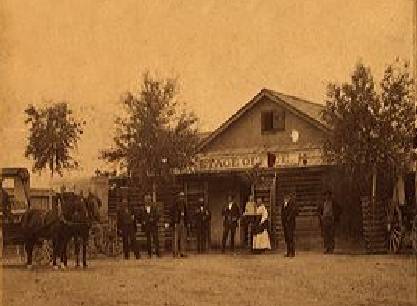
At its first peak in the late 1860s, Wickenburg was an adobe village of about 200–250 on the river. Visiting Army inspector James Rusling described it in 1867–68, with a 100-yard Main Street, two hotels (the Bradshaw and A.H. Peeples' Arizona Hotel), the Magnolia Saloon, and the Vulture company's new 20-stamp mill a mile upriver. It stood at the junction of the La Paz/Ehrenberg road to California, the road to Prescott, and the track down the Hassayampa to Maricopa Wells. Merchants such as A. Barnett, C.T. Rogers, M.L. Peralta, Heyman Mannasse and Barnett & Block supplied the mines. River ranches such as those of Wilson, Brill, Smith and Henry Wickenburg himself grew grain, beans, melons, potatoes, peaches and the first apples Prescott had seen in years.
Wickenburg founded Phoenix. In 1867 the Swilling Irrigation Canal Company was organized in Wickenburg with $10,000 capital; Jack Swilling and Henry Wickenburg were among the first shareholders. In December about 16 men left town to dig the Swilling ditch in the Salt River Valley, the start of modern Phoenix. For their first year, Phoenix's settlers bought their supplies in Wickenburg.
Malaria and the bust. A malaria ("Panama fever") epidemic in the summer of 1867 was blamed on a stagnant pond on Wickenburg's ranch and gave the town an unhealthy reputation for years. The mine hit water at about 300 feet in 1871–72. The Panic of 1873 shut it, and in 1873–74 the county sold it for back taxes. By January 1875 the Prescott Miner called Wickenburg "only a wreck of its former self." In 1883 a visitor found "a relic of the past, with 100 houses standing empty."
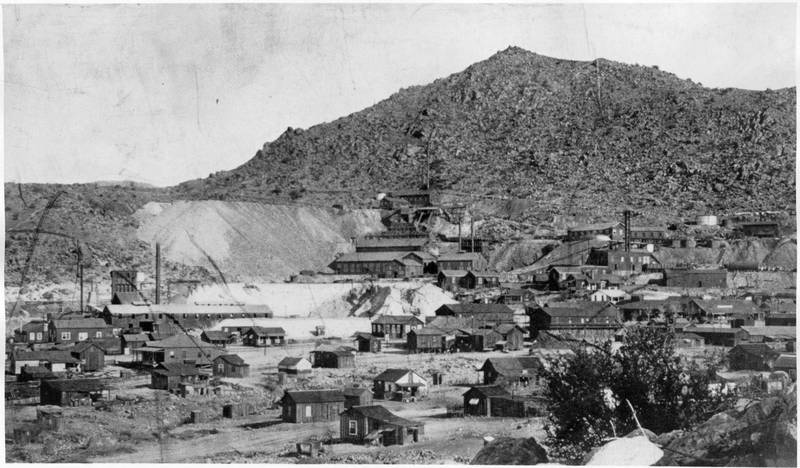
The second boom. In 1878–79 James Cusenbary and James Seymour bought up the Vulture claims for Eastern investors as the Central Arizona Mining Co. They built a mill town, Seymour, about 10 miles downriver; its post office opened June 1879. They then built an 80-stamp mill at the mine itself, fed by a 14.5-mile pipeline that lifted about 400,000 gallons a day up 320 feet from the Hassayampa. It was running by November 1880. The company took out more than $2 million but still lost money, and the second boom was over by 1884. Colorado silver king H.A.W. Tabor bought the mine for $265,000 in 1887. It went bankrupt and was sold at a sheriff's auction in 1897.
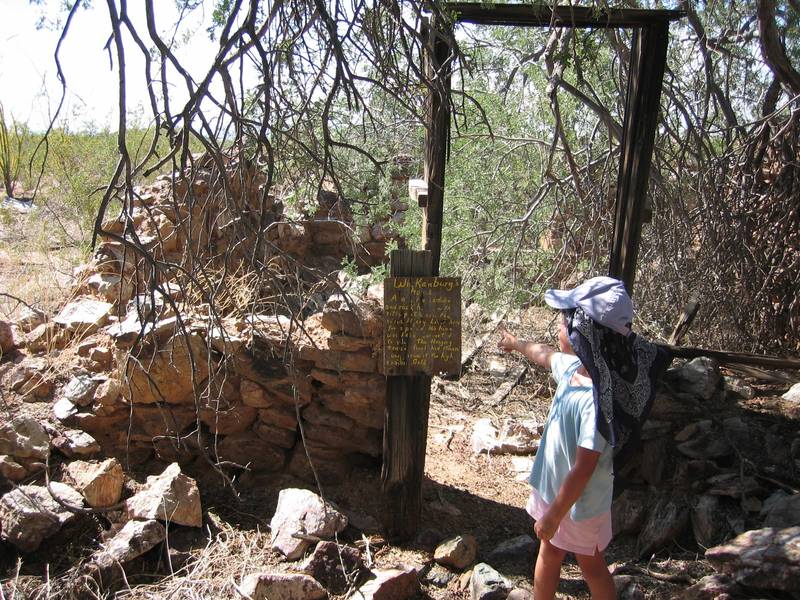
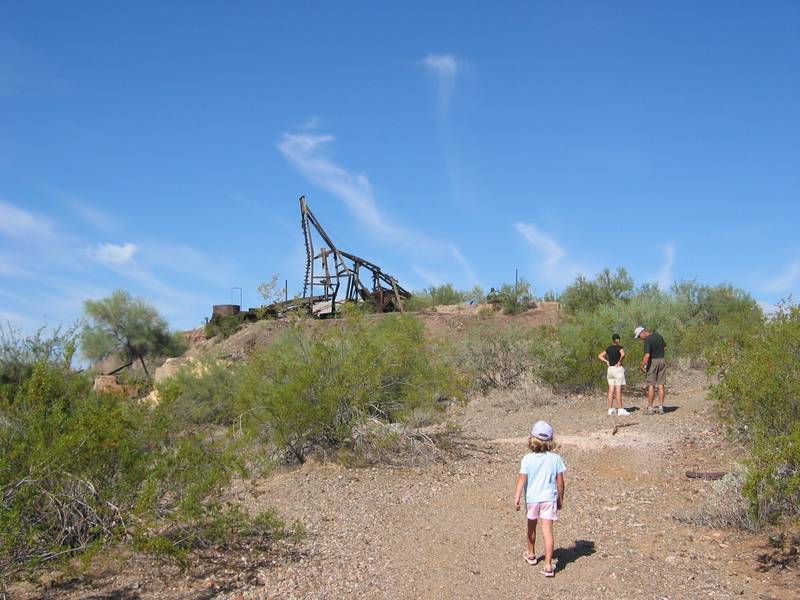
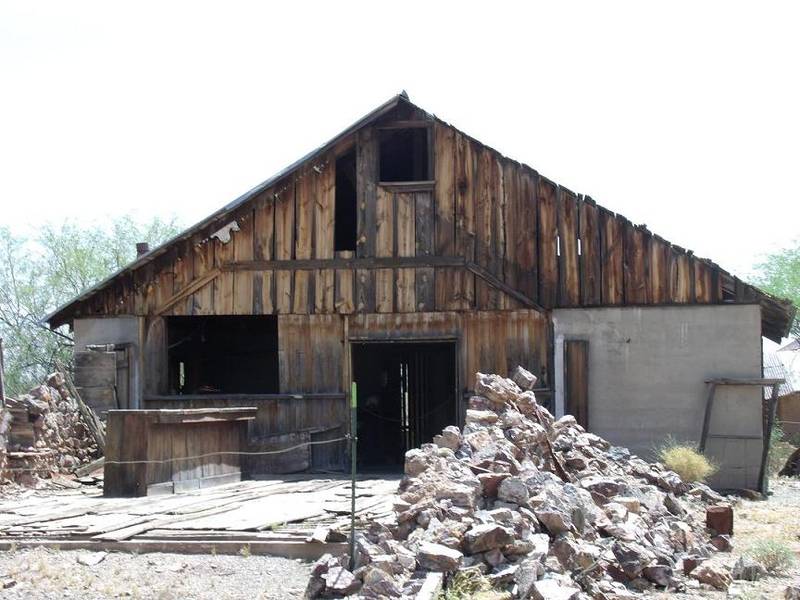
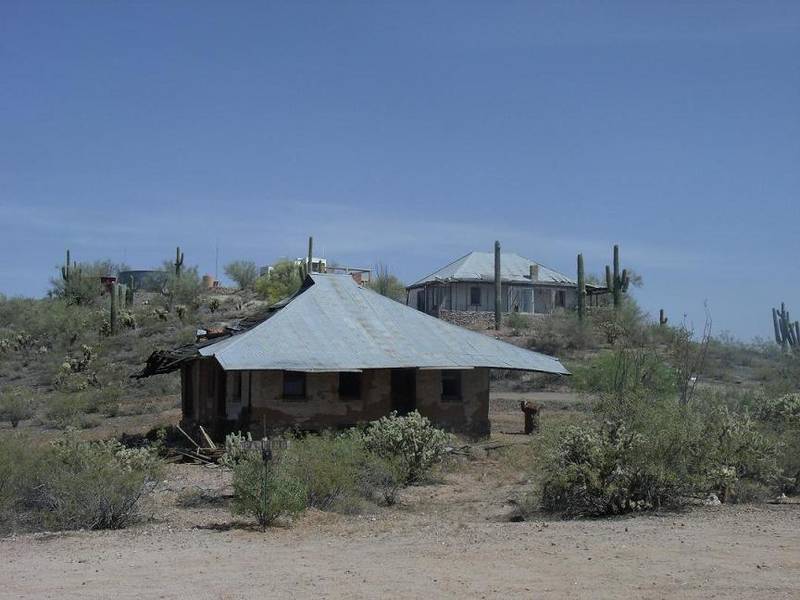
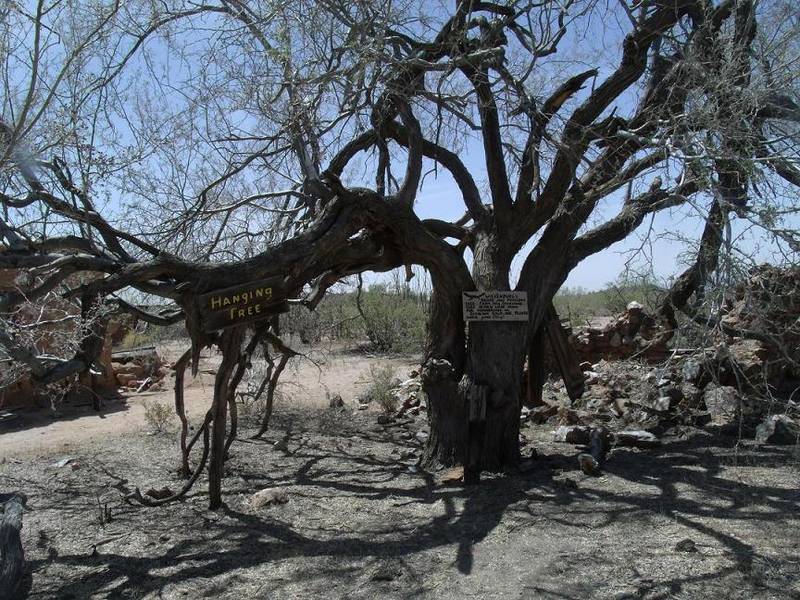
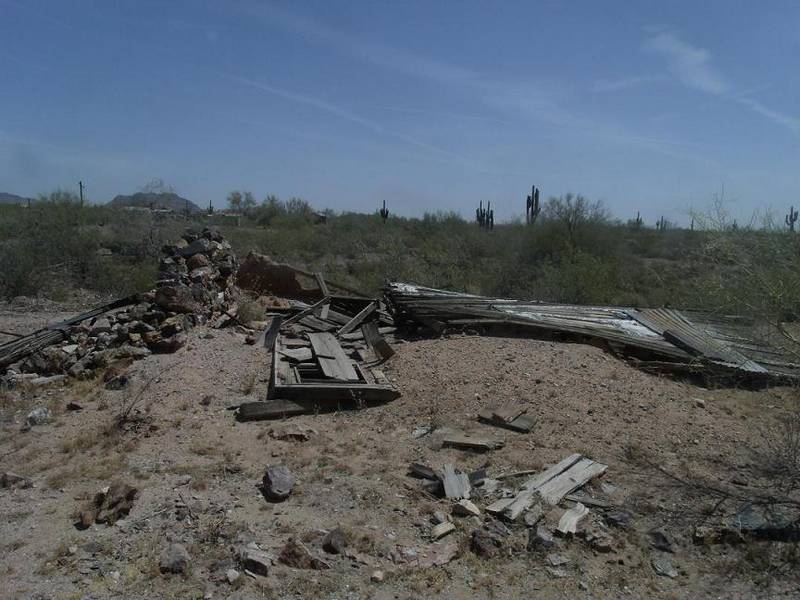
Vulture City. The name first belonged (by 1870) to the company's mill settlement a mile above Wickenburg. It moved to the mine site with the 1880 mill, and Vulture City got a post office on October 4, 1880. Today the stone assay office (1884), the ruins called "Henry Wickenburg's house," the ironwood "Hanging Tree" and the Verde Flat Cemetery are a privately owned ghost-town attraction.
Legend: "Vulture City, population 5,000." No census or contemporary source supports it. About 150 men worked the mine in 1870. Nor is there a record that Henry Wickenburg lived in the stone house shown as his at the mine.
Legend: "Wickenburg missed being territorial capital by two votes in 1866." The town's own website and the 1986 NRHP nomination repeat it, though the nomination hedges ("it is reported"). The documented votes are from the 1864 Legislature, when amendments to move the capital to La Paz, Walnut Grove (on the upper Hassayampa) and "Aztlan" each lost 9 to 8. The Wickenburg story may be a garbled memory of the Walnut Grove vote. The 1866 legislative journal has not been checked.



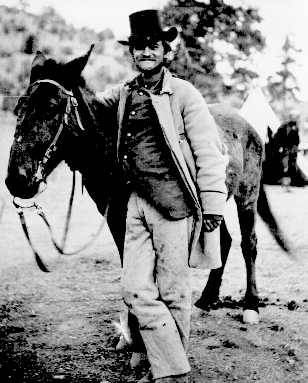

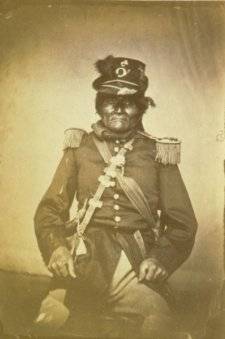

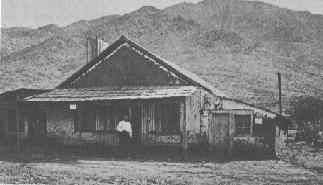

4. The railroad and the new town
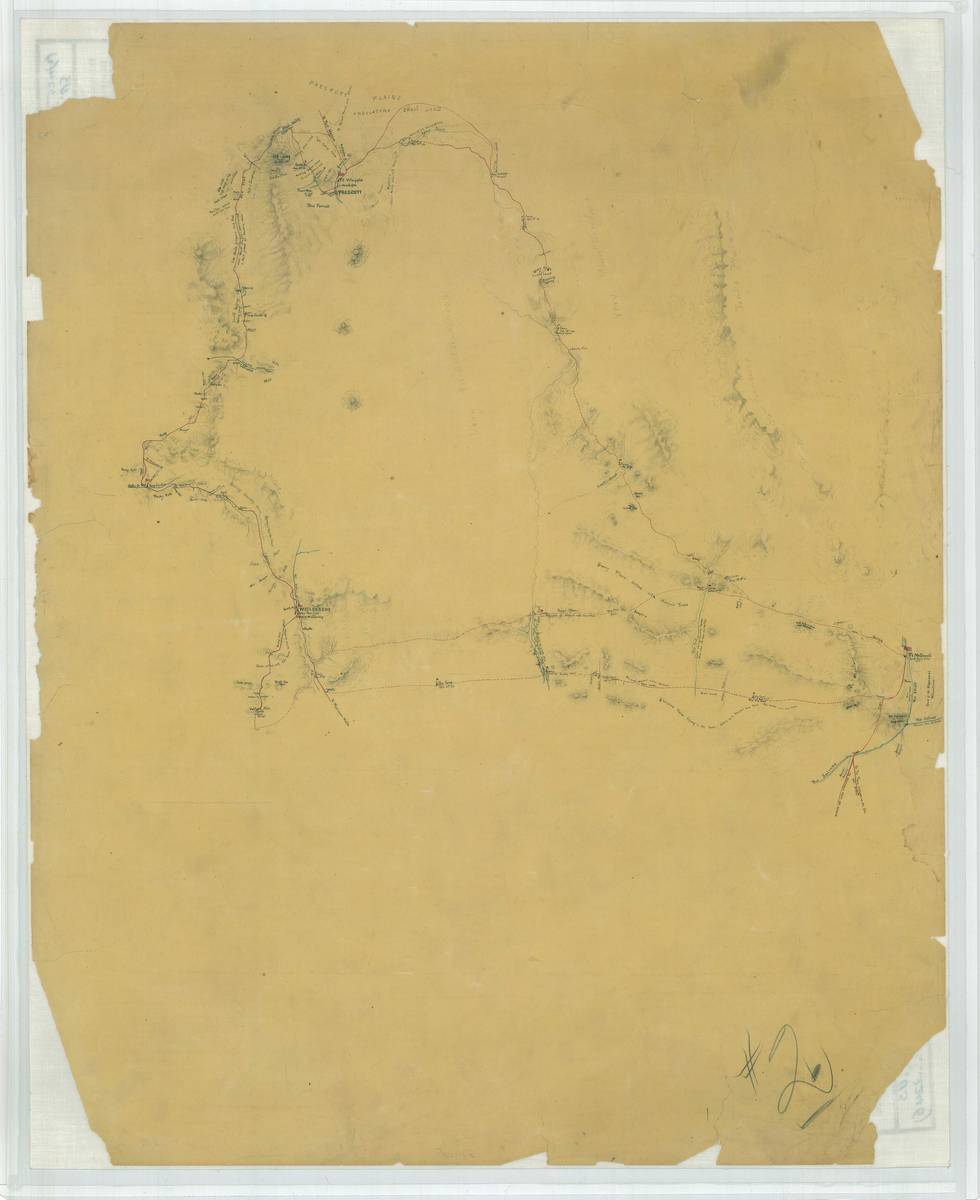
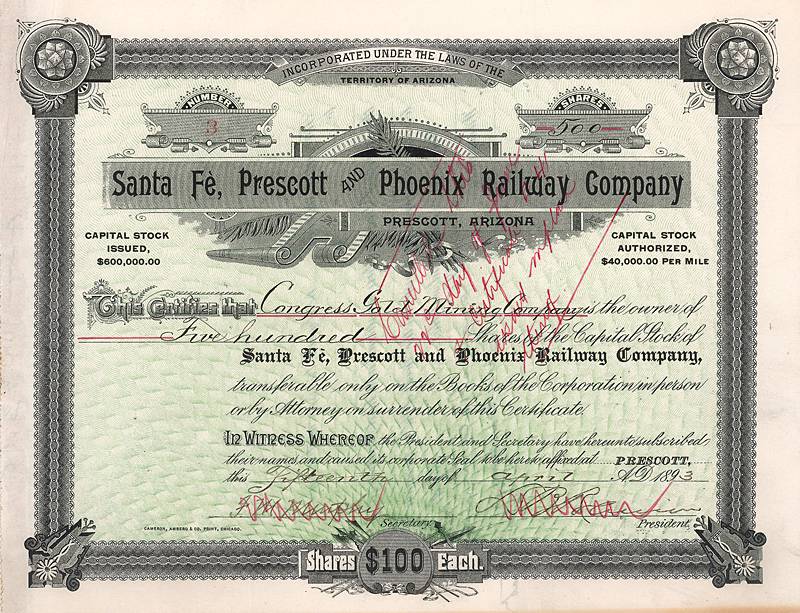
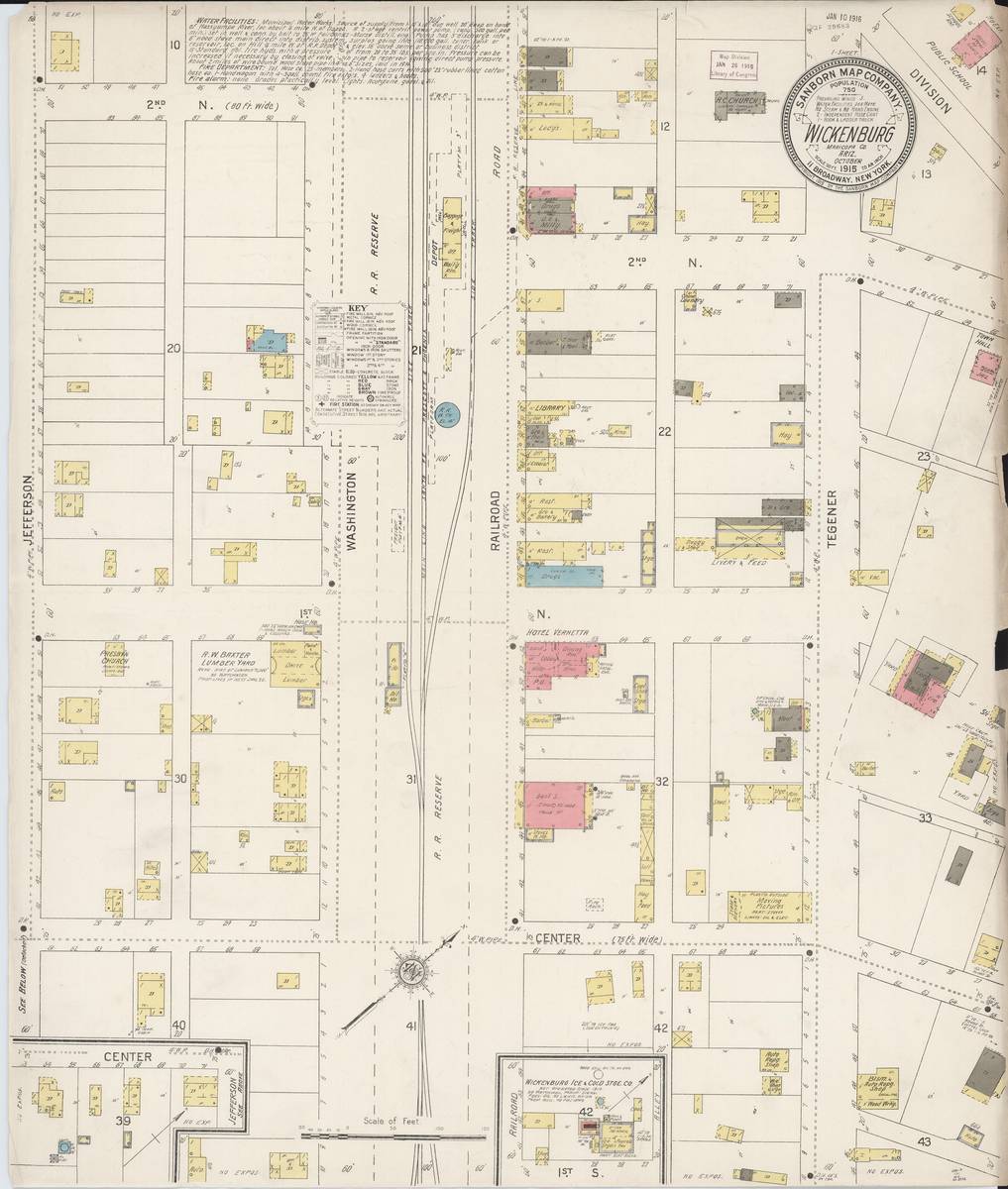
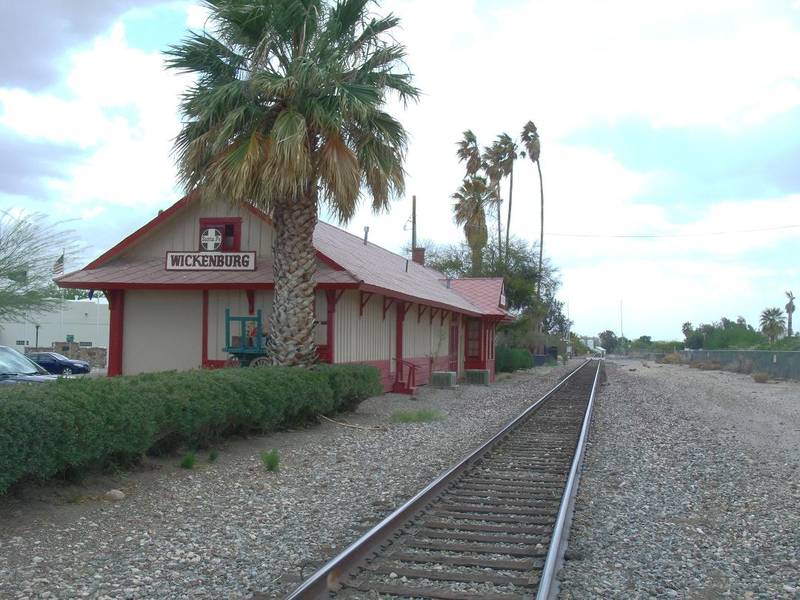
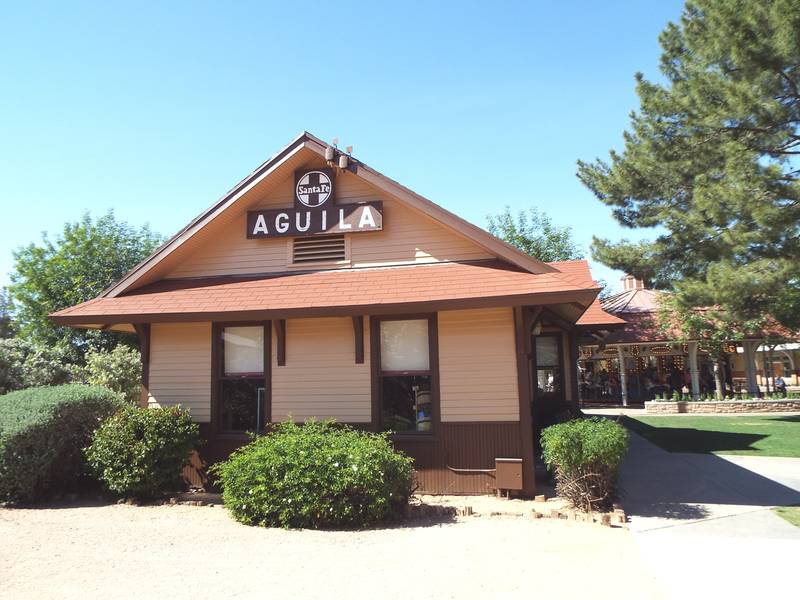
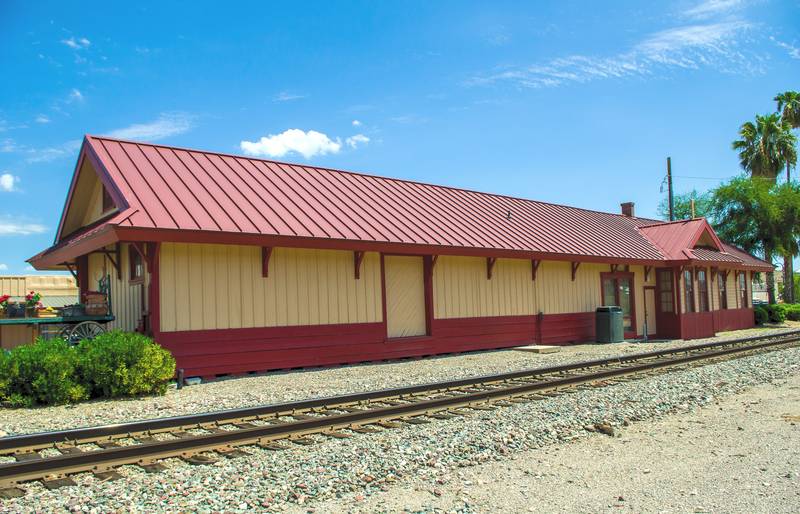
The Santa Fe, Prescott & Phoenix Railway, Frank M. Murphy's "Peavine," built south from Ash Fork and reached Wickenburg in December 1894. Henry Wickenburg granted it an easement. The line reached Phoenix in February–March 1895 (sources give Feb 28 and Mar 13), and the board-and-batten depot followed in 1895, traditionally dedicated July 29. Business moved from the old stage road by the river to Railroad Avenue (now Frontier Street). The townsite was surveyed in 1898 by Becknell and Titus and recorded on September 23, 1898, the first legal plat; Robert Groom's 1868 plat had never been filed. The 1907–1910 Arizona & California "Parker Cutoff" made Wickenburg a junction on Santa Fe's route to Los Angeles.
Part II: Crime, Violence and Death
This catalog covers about 84 incidents, 1866–2025, in Wickenburg and the surrounding mining camps. Each is tagged by the quality of its evidence: Documented (a contemporary record), Legend, or Reminiscence (a recollection told decades later).
5. The Wickenburg Massacre, November 5, 1871
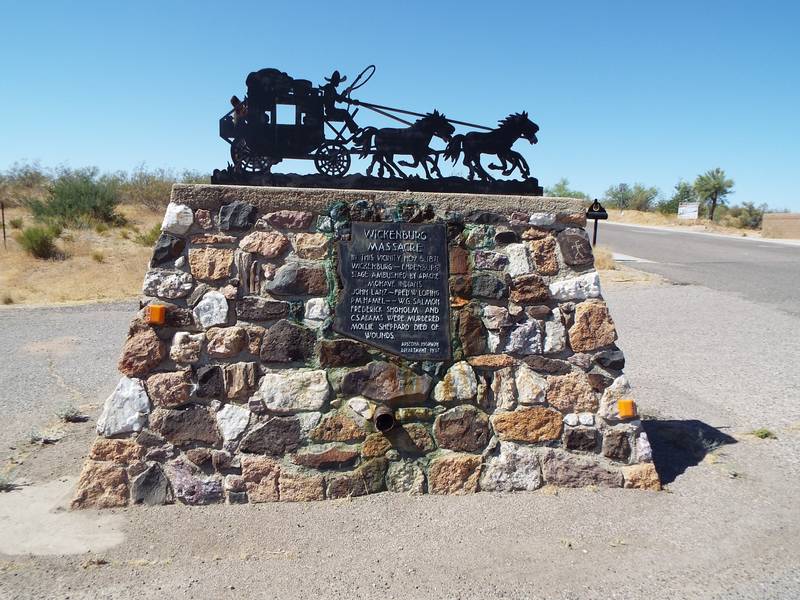
The most famous crime in Wickenburg's history happened on the stage road about eight miles west of town. An Arizona Stage Co. coach left Prescott on the night of November 4 bound for Ehrenberg and San Bernardino. In mid-morning on November 5, among the boulders toward Culling's Well, it was ambushed.
Killed at the scene: - John Lance ("Dutch John," spelled Lentz in 1872 papers), the driver - Frederick Wadsworth Loring, 22, a Harvard graduate and Appleton's Journal correspondent heading home from Lt. George Wheeler's survey - Peter M. Hamel, Wheeler Survey topographer, scalped - William George Salmon, Wheeler Survey, who ran about 50 yards before he was killed - Frederick W. Shoholm, passenger - Charles S. Adams, passenger
William Kruger and Mollie Sheppard were wounded and escaped down an arroyo, where an eastbound mail wagon picked them up. By Kruger's account Sheppard later died of her wounds, making seven deaths; historian Jan MacKell Collins has questioned what really became of her.
The coroner's jury (foreman Jack Morris; jurors included Aaron Barnett, Julius Goldwater and Dennis May) found that the six "came to their death by gunshot wounds received at the hands of Indians trailed towards the Date Creek Reservation."
Who did it?
- Yavapai from Date Creek. This was the official conclusion. General George Crook's ten-month inquiry named Ochocama (Ohatchecama), a Tolkepaya leader, and estimated that about 50 men took part. The Mohave chief Irataba reported that the attackers had boasted of it.
- Mexican bandits disguised as Indians. Pioneer Charles Genung argued this to the end of his life (1911). The attackers left horses, jewelry and blankets behind, and investigators noted moccasin tracks and 17 bullet holes all fired from one side. Genung named a ringleader, "Juaquine Barbe," whom he said Phoenix deputies later killed. His evidence was mostly secondhand.
- White robbers after money Sheppard was said to carry. This was conjecture only.
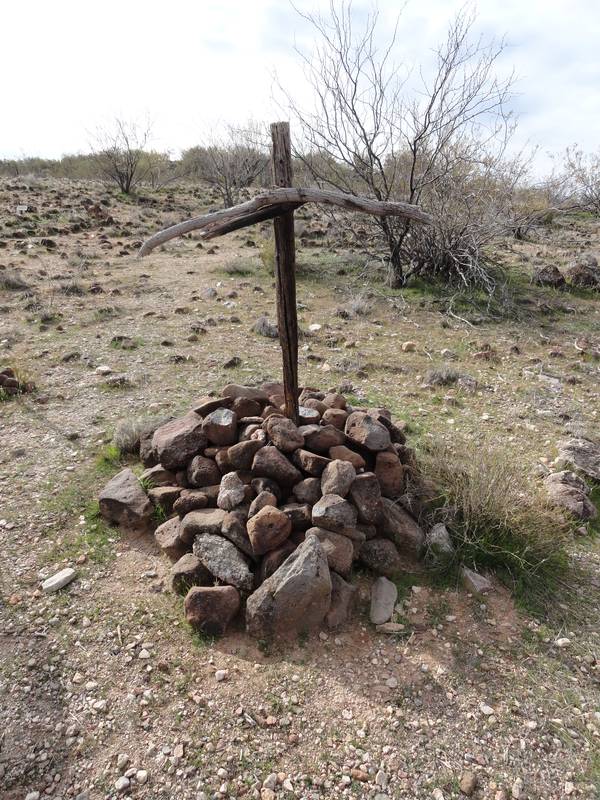
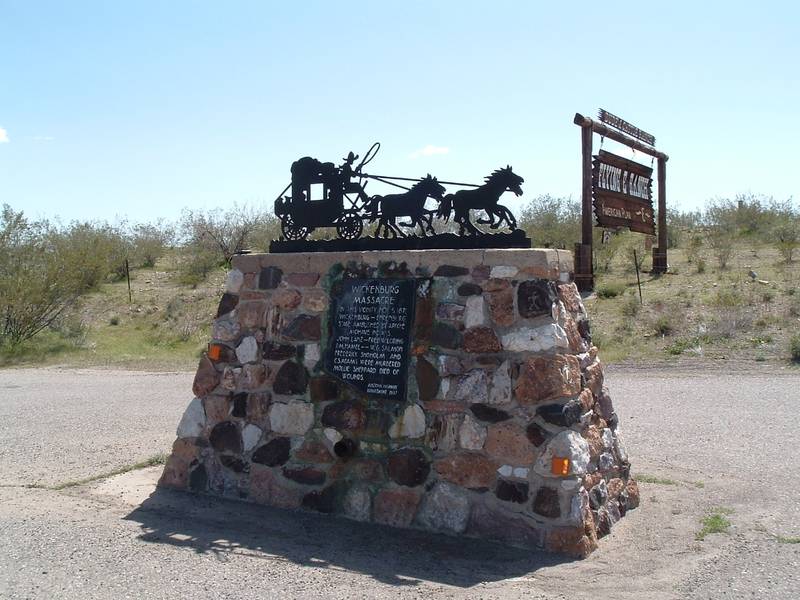
Aftermath. In September 1872 Crook went to Camp Date Creek to make arrests; a soldier was stabbed and "indiscriminate shooting" followed. Ochocama was wounded but survived. A 1927 reminiscence claims Crook himself knifed a suspect and swore witnesses to secrecy; nothing corroborates it. Late that month troops pursued alleged participants to Burro Creek, where about 40 Yavapai were killed, many with no tie to the massacre. Five of the dead were buried in Wickenburg on November 6, 1871, and those graves were disturbed in 1949. Monuments were placed in 1937, 1948 and 1988, and the case appeared on Unsolved Mysteries in 1996. It remains officially unsolved.
6. The territorial era, 1866–1899
- c. Feb 1866, King's Well, La Paz road. Two army deserters shot well-digger "Dan" in the back. His partner Dave King survived by hiding at the bottom of the 125-foot shaft. Creed Bryan and Joe Blackwell tracked the killers to the Salt River and shot both. (Reminiscence, 1894.)
- Mar 27, 1871, White Picacho. Texan Col. Jacob Snively was mortally wounded in an attack by Tonto Apache or Yavapai, about 15 miles northeast of town.
- c. Mar 11, 1873, the "Second Wickenburg Massacre." A.C. Swain, John McDonald and George W. Taylor were killed separately on the Hassayampa about 10 miles below town. Taylor, 21, was the son of the Vulture's superintendent; his body was mutilated with spears. Troops and scouts from Camp Date Creek followed the trail. (Documented: Arizona Miner and Arizona Citizen, March 1873.)
- Apr 20, 1875, murder of Heyman Mannasse. Freighter Jesus Amado quarreled with the merchant, a former Wickenburg postmaster, over the price of barley. Amado came back armed and shot him in the back while he was reloading. Dr. J.H. Pierson held the inquest. Amado escaped and was never caught.
- 1877, two stage robberies, one of them an inside job. On January 4 the Prescott–California stage was robbed near Woolsey Hill; the robbers were caught the next day. On May 12 the Prescott–Ehrenberg stage was robbed west of Wickenburg. A federal grand jury found that John Mantle, a detective hired by the Post Office to catch stage robbers, had planned that robbery himself.
- Aug 9, 1877, Antelope Station. William Partridge shot stage-stop owner George "Yaqui" Wilson after a long feud. He was sentenced to life at Yuma and pardoned by Gov. John C. Frémont in 1880.
- Apr 18, 1878, Jack Swilling accused. Three hooded men robbed the California stage four miles out of Wickenburg. Jack Swilling, the founder of Phoenix, was arrested with Andrew Kirby; they said they had been digging up Col. Snively's remains for reburial at the time. Swilling died in the Yuma jail on August 12, 1878, before trial.
- c. July 22, 1886, the Martin Family Massacre. Storekeeper Barney Martin, his wife Rosie and sons John (13) and William (11) left Weaver for Phoenix with about $4,000 in gold. A search party led by Charles Genung found their burned bodies and wagon weeks later. Rewards totaled $2,250. Suspicion fell on rival storekeeper Charles P. Stanton and on outlaw gangs, but no one was ever convicted. The family's graves are in today's Hassayampa River Preserve.
- Nov 13, 1886, Stanton assassinated. Charles P. Stanton, long suspected of directing robberies and murders around his store, was shot dead there by Mexican assailants. Tradition says it was revenge for an insult to a young woman. Unsolved.
- c. Mar 19, 1888, the Vulture bullion murders. Superintendent Cyrus Gribble and guards John Johnson and Charles Doolittle were ambushed at night on the Vulture–Phoenix road while carrying a gold bar. Tabor, the territory and both counties posted rewards. By McClintock's account the killers were Inocente and Francisco Valenzuela and a younger man. Inocente was shot by a posse when he went back for the cached bar; Francisco fled to Sonora and reportedly confessed before dying there in 1914. Many retellings give "Josiah Gribble," 1887 and a guard named "Littlefield"; the 1888 newspapers and the governor's proclamation give the names and year above.
- Mar 28, 1896. German-born prospector Frederick Morisse was found hanged at Wickenburg; the coroner ruled suicide.
- Nov 11, 1898, Castello/Trilby mine. Superintendent William Murphy was shot from behind by two prospectors and killed one of them, Bernal, before he died himself. The other, Sweninger, was jailed at Prescott; the outcome is unknown.
- 1898, Weaver. The murder of saloon-keeper William Segna helped empty the lawless camp of Weaver.
- Jan 30–31, 1899, a constable kills a miner. Wickenburg constable Henry "Red Shirt" Wilson, an ex-convict and pardoned shooter, had insulted women at a local dance. Miner James C. Davenport and the Kellogg brothers came to his house, and Wilson fired a shotgun into the group as they left, killing Davenport. He was convicted of second-degree murder and given 15 years at Yuma.
7. Two famous legends
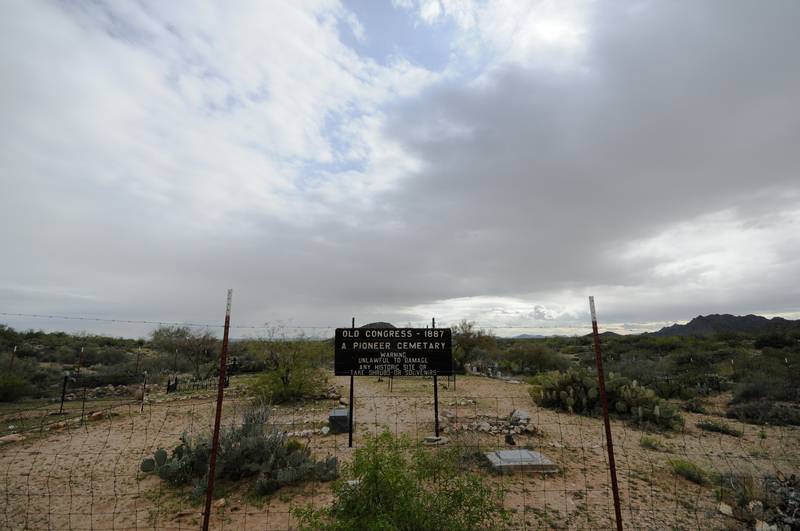
Legend: The Vulture "Hanging Tree." Tour guides say 18 men were hanged from the ironwood at Vulture City, mostly for high-grading. No names, dates or newspaper reports have been found for any of these hangings, and a historical society docent states there is no record that the tree was ever used for one. What is documented is the theft behind the story: miners smuggled gold out in lunch pails, pant legs and saddlebags for decades. The Verde Flat Cemetery nearby holds about 100 marked and perhaps 100 unmarked graves, mostly of children who died of diphtheria, typhoid and smallpox.
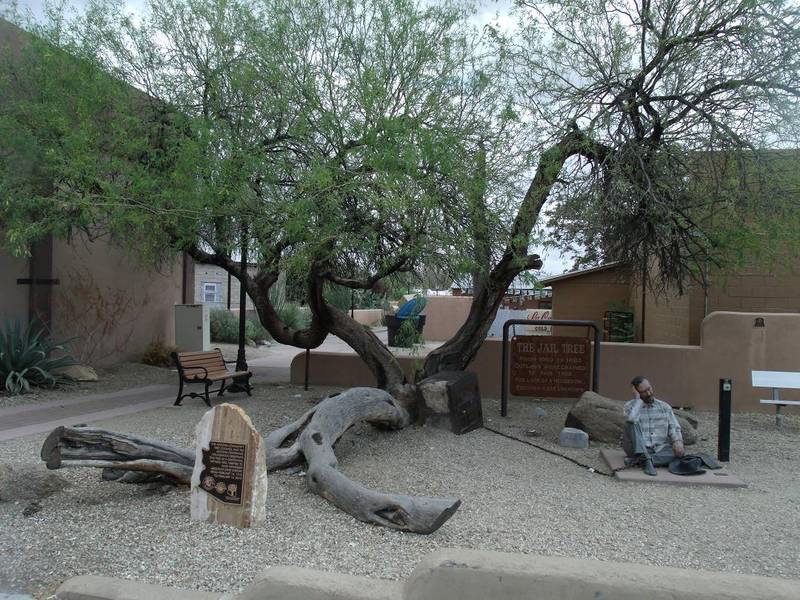
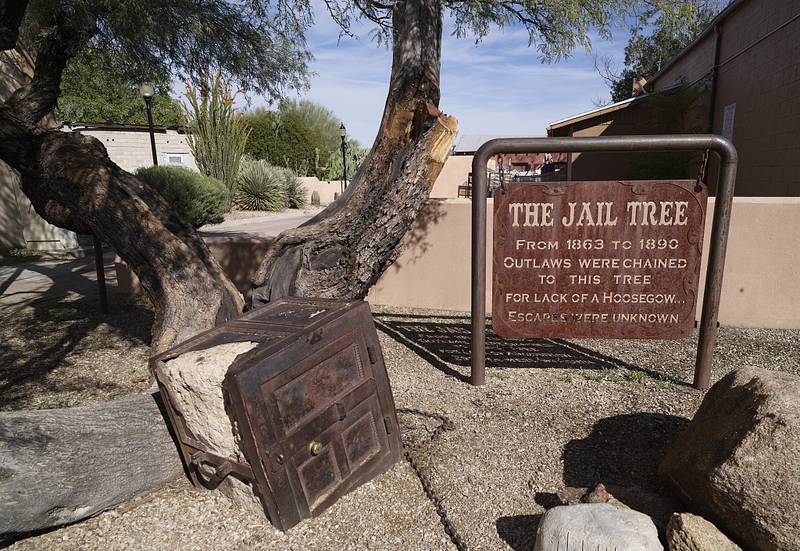
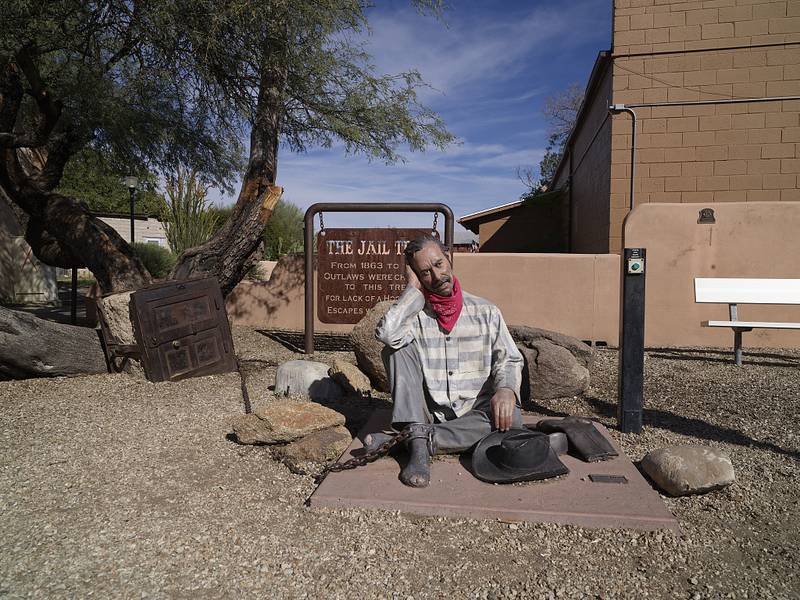
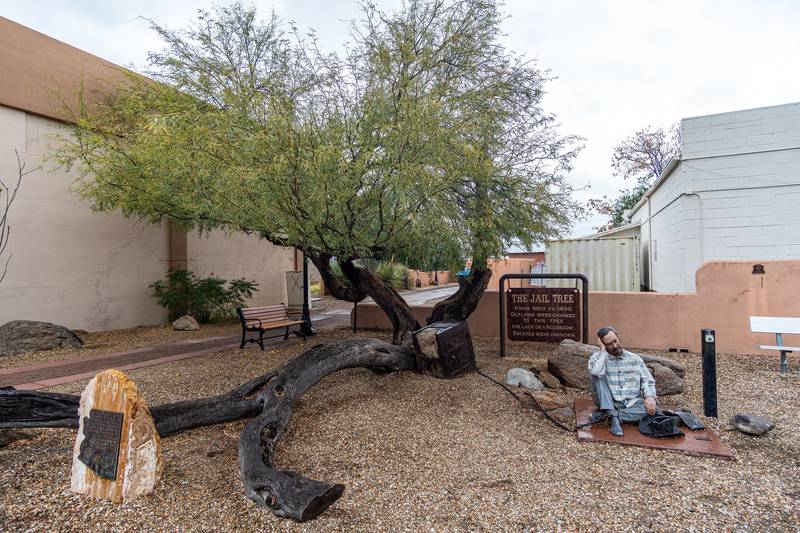
Legend: The Jail Tree. Lawmen supposedly chained prisoners to the old mesquite at Tegner Street and Wickenburg Way from 1863 to 1890, while their families picnicked beside them, and "no one ever escaped." It is the town's signature landmark and an Arizona Centennial Witness Tree. No contemporary record has been found. A Yuma Sun garden columnist suggests the tree may have been planted in the early 1900s. A former resident who grew up in Wickenburg in the 1930s recalled that the tale grew from parents threatening to chain unruly children to it.
Legend: The Glory Hole collapse. Tours say a 1923 cave-in caused by high-graders entombed 7 miners and 12 burros (17 men in one version). No 1923 report has been found. Two Bisbee Daily Review articles from 1908 describe an earlier great cave-in, so old its date "has even been forgotten." Nearly 20 men were trapped in it and all dug their way out alive. The fatal version may be a later embellishment of that event.
8. The death of Henry Wickenburg, May 14, 1905
On Sunday, May 14, 1905, the children of neighbor J.W. Etter found the 85-year-old founder in a mesquite grove between their houses, below what was later the John Boetto home. He had a .32-caliber bullet wound in the right temple, the revolver in his right hand, and powder burns on the temple and forefinger (Arizona Republican, May 15, 1905). Justice of the Peace Hector Riggs, acting as coroner, empaneled a six-man jury that included J.K. Murphy, J.W. Etter and Henry Cowell. It ruled suicide, attributed to "melancholy" from old age and failing fortunes. He had once been worth perhaps $50,000 and now held only "meager property holdings."
Why people doubted it. - Two years earlier he had signed his personal property over to his caretaker, Helene Holland, who inherited the rest. A historical society docent has suggested Holland "may have been the one to pull the trigger." - Wikipedia says a "Sheriff Murphy" doubted the verdict. That may be a muddle with juror J.K. Murphy. - A modern claim that Wickenburg was left-handed has no source. - In 1924 the Phoenix Gazette wrote that "he shot himself, that much is known definitely," and passed on a rumor that he had taken up spiritualism and been persuaded "the spirits needed him in heaven." - A 1944 Arizona Highways article put the death on July 4 and the weapon as "an old Colt"; both details are wrong.
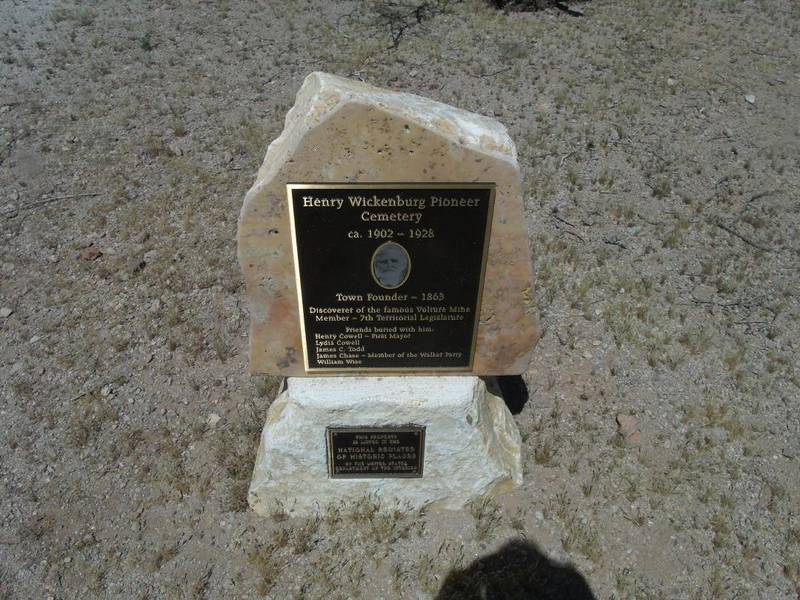
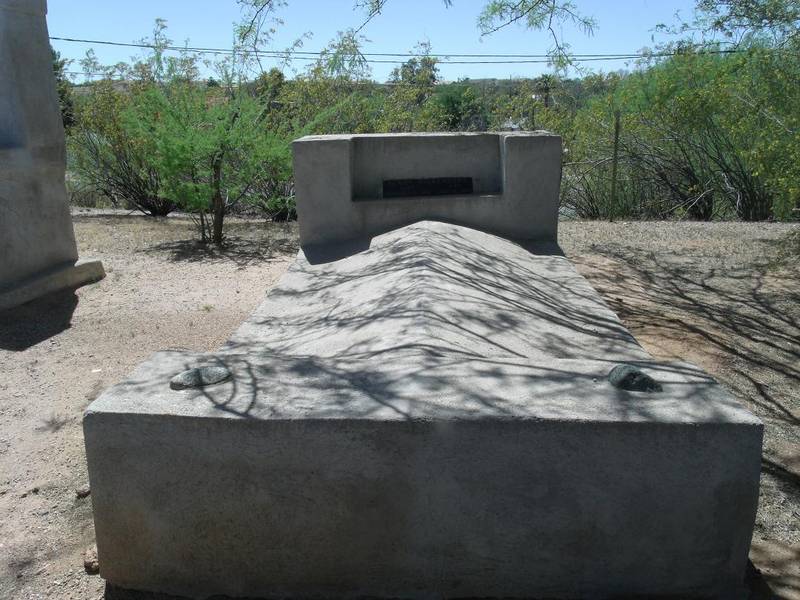
He is buried on the knoll of his old ranch, in the Henry Wickenburg Pioneer Cemetery (NRHP 2011), beside his friends the Cowells.
Assessment: The contemporary physical evidence (right hand, right temple, powder burns) is consistent with suicide. The murder theory rests on motive and later local tradition, not on evidence.
9. 1900–1960: mines, rails, bootleg and the highway
- Jan 4, 1902. Cattleman George W. Bryan, about 75, was shot by miner William Connors in a quarrel over a slaughtered calf near Gilbert. Connors got 18 years at Yuma.
- Jan 1902. A fatal stabbing at Congress after a fire; Joe Soto was jailed for murder.
- Feb 1904. An unidentified skeleton was found near the Date Creek pumping station with laudanum and chloroform bottles beside it ("Was It a Case of Suicide?").
- July 1904. The body of Blas Contreras was found near town. Two boys were arrested and released. Unsolved.
- Feb 1914. An underground blast killed two Italian miners at the Vulture.
- Nov 22, 1921. A Santa Fe inspection motor car went off a 20-foot embankment three miles north of town, killing five railroad officials: W.H. Oliver, Supt. William Matthie, H.C. Storey, John Jaeger and Wickenburg roadmaster W.S. Bowman.
- 1922. Mine superintendent John Gace fell 250 feet down the Mizpah incline.
- 1923. Joe Nunez died of bootleg liquor. The State Miner called "the frequency of crime … in the small community of Wickenburg during the past three years … shocking."
- c. Sept 20, 1923. A detoured Santa Fe transcontinental train derailed near Hot Springs Junction, killing 4 crew.
- Mar 7, 1924. Train No. 42, which had left Wickenburg at 8:20 PM, was derailed north of Congress by a deliberately unbolted rail, and the engineman was killed. Some online summaries date this to 1934.
- May 1924. A young Phoenix attorney, Walter A. Davis, took his life during a trip to Wickenburg.
- 1925. Texas oilman John J. Knight vanished at the Hassayampa crossing. His skull was found months later in the White Tanks, and whether it was thirst or murder was never determined.
- Feb 7, 1945: Night watchman Clarence N. Dotson. He surprised a burglar at the Hassayampa Drug Store downtown and was shot three times, returning fire before he died. The 34-year-old suspect was caught after hijacking a bus and was sentenced to life; he escaped from prison twice, in 1953 and 1968. Dotson is the only line-of-duty death in Wickenburg Police Department history.
- 1948 and 1950. The Wickenburg Sun reported the suicides of two aging, ailing men, prospector Will Davis, 76, and Frank Alt, 61.
- 1953. Twelve highway deaths in the Wickenburg patrol area by mid-August.
- Jan 5, 1960. Hitchhiker Lewellyn McGee Jr., 19, shot Wade H. Strickland, a cotton council representative who had picked him up near Banning, California. He left the body on Highway 60 just east of town and was arrested in Phoenix in the dead man's car. He confessed: "I'd do it again."
10. 1970 to today
- June 1972. MCSO deputy Ralph "Skip" Butler, 32, a Wickenburg High graduate, was killed when his patrol car was hit by a semi on US 60 as he answered a fatal crash.
- Jan–Feb 1991. The body of Wendell Warner, 29, strangled after leaving a Phoenix bar, was dumped at the Hassayampa River Preserve. Perry Matthew Taylor was convicted.
- Apr 23, 1999. William Rodriguez, 39, and Rebecca Rubalcava, 20, were found shot in the head in a ditch off US 93 north of town. An unsolved Yavapai County cold case.
- 2001. An unidentified woman was found near SR 74 (Doe Network 218UFAZ).
- 2002, Morristown. Peter K. Ross shot his wife, her 17-year-old daughter and her 13-month-old grandson. He pleaded guilty and received three consecutive life terms (2006).
- 2004. Bret Smalling was killed (three suspects charged). The body of Timothy Smith, 22, was found near Vulture Mine Road and ruled a homicide. Outcomes of both are unknown.
- May 2019. Skeletal remains of a young man in a military-style jacket were found in the desert. The FBI's ViCAP lists the death as a homicide; he is unidentified.
- 2020. The remains of Amalia Sanchez-Hernandez were found off Wickenburg Road. Unsolved.
- May 5, 2021. Lorenzo Rodriguez Chavira, 64, was found dead in his home west of US 93. In April 2026 a suspect was arrested in Indiana; the case is pending, and the charges are allegations only.
- 2020s. Several shooting deaths are still under investigation or have no reported ruling (Weaver Drive, Jan 2025; Santa Fe Drive; and others).
11. The highway toll
US 60 (the old "California highway") and US 93 (the Joshua Forest Parkway to Las Vegas) have killed more people around Wickenburg than any outlaw. - 1953: twelve patrol-area deaths in seven and a half months. - 2015–2020: ABC15 counted 35 deaths on the 79-mile Wickenburg–Wikieup stretch, and Value Penguin ranked US 93 in Arizona the most dangerous highway in the country. - Apr 2, 2021: a wrong-way pickup with no headlights killed five on US 60 near Morristown.
ADOT has since spent more than $500 million widening the road.
Part III: Disasters and Big Events
12. The Walnut Grove Dam disaster, February 22, 1890
This was the deadliest disaster in Arizona's territorial history and the event that ended Wickenburg's farming economy.
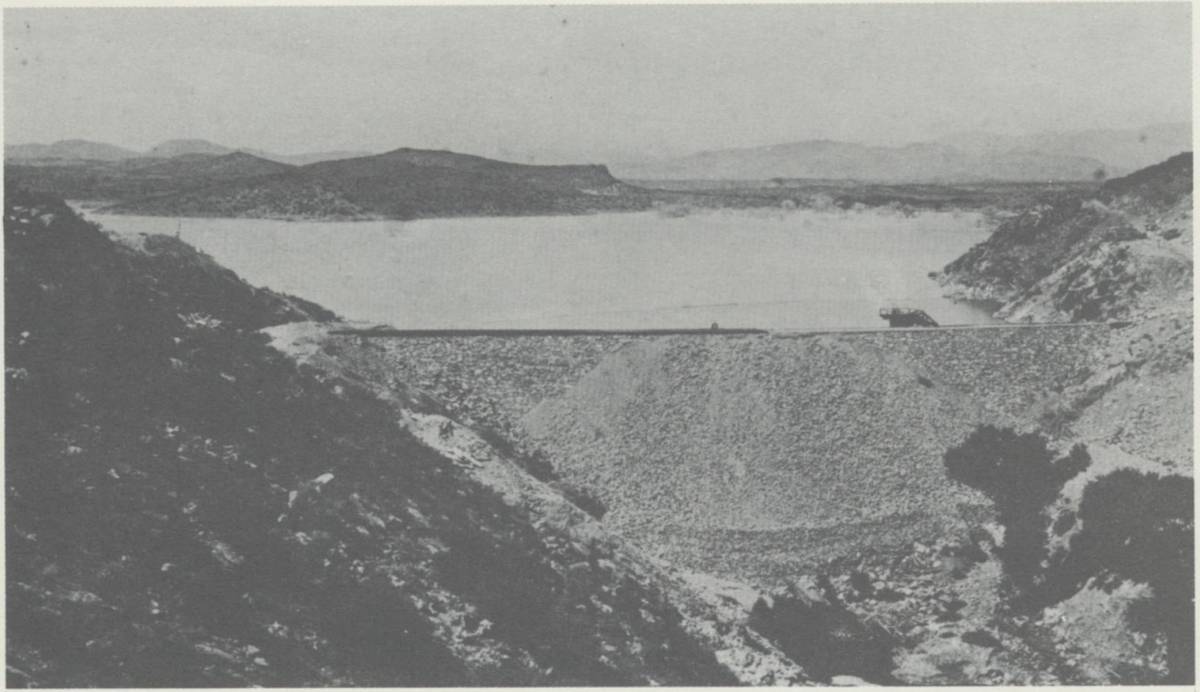
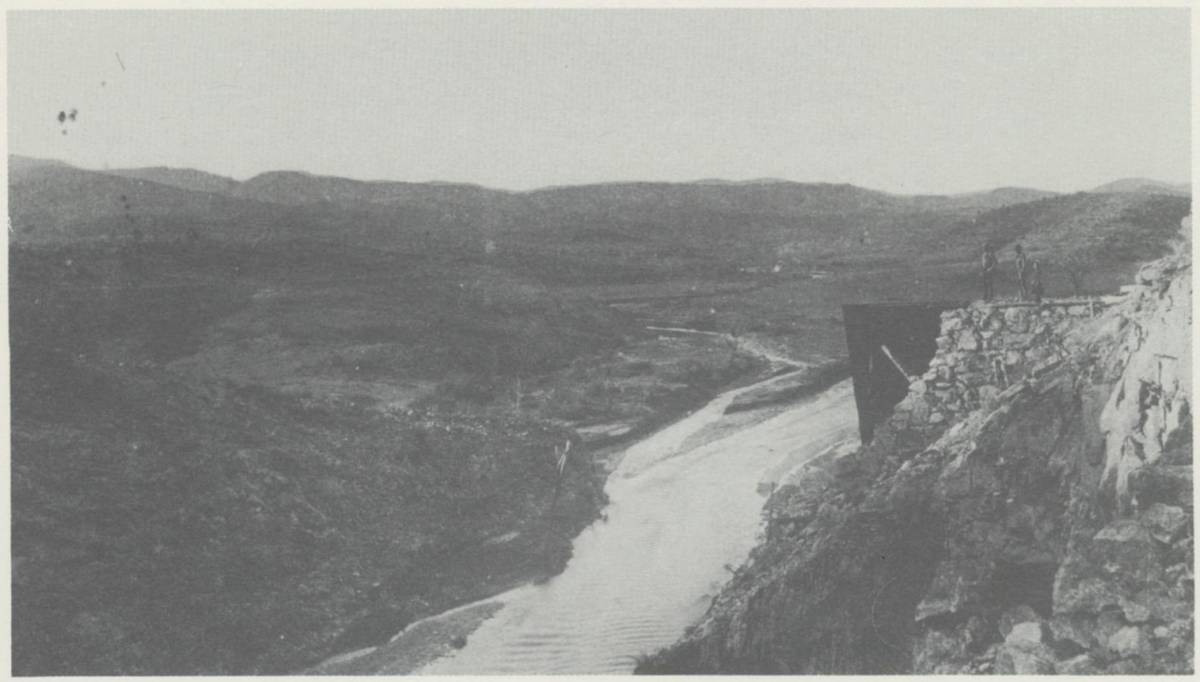
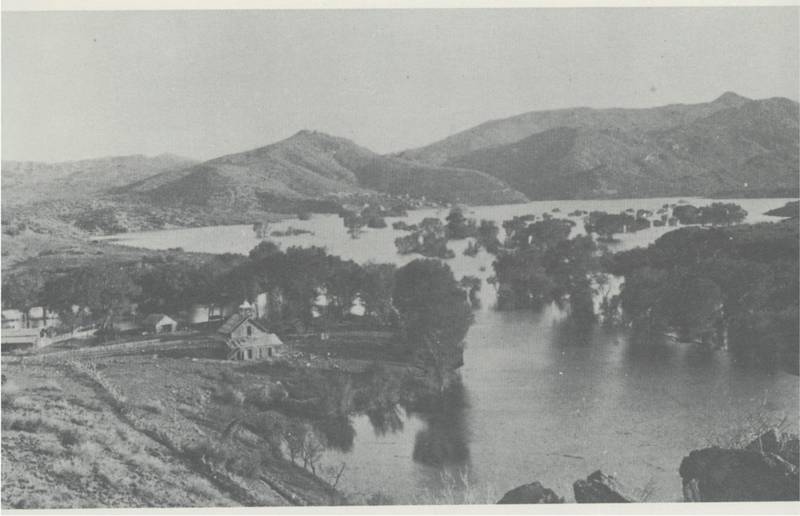
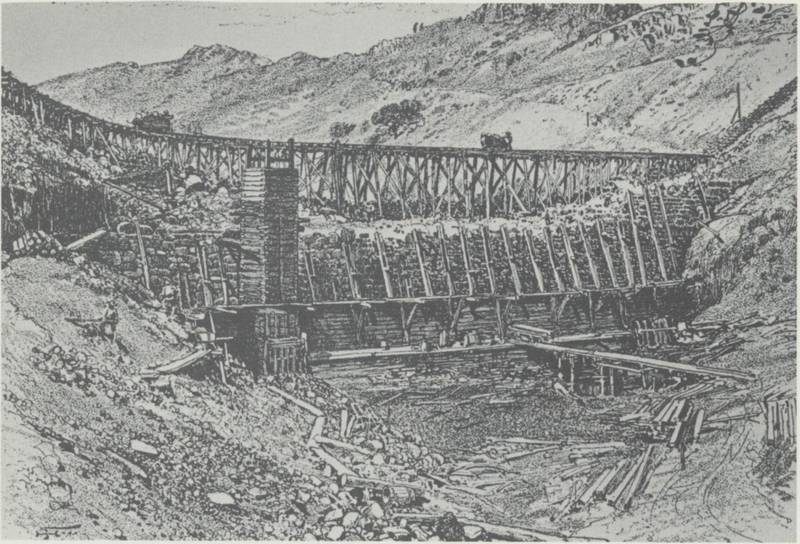
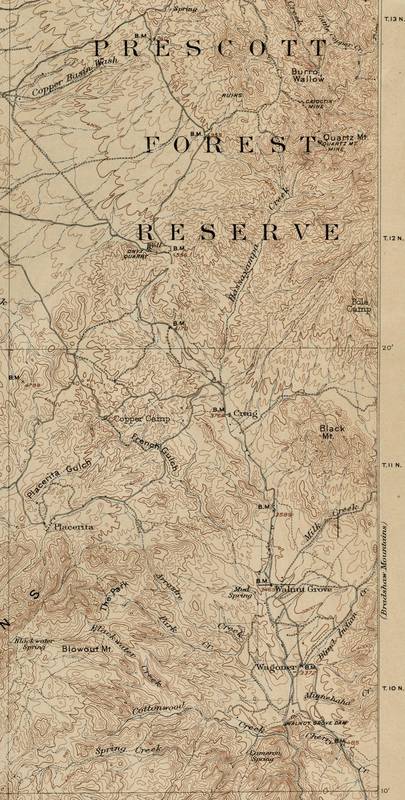
The dam. The Walnut Grove Water Storage Company, backed by New York millionaire Henry S. Van Beuren, built a 110-foot rockfill dam on the upper Hassayampa about 20 miles above Wickenburg in 1886–88. It was meant to supply hydraulic gold mining and irrigation. Five chief engineers came and went. One, E.N. Robinson, designed a large spillway and was fired. Walter Bates, a former salesman in his twenties, built a smaller, cheaper one. Luther Wagoner called the work "full of blunders." The last engineer, Alexander O. Brodie, later became territorial governor. The spillway could pass only about 2,200 cubic feet per second, roughly a 2- to 5-year flood.
The night. Rain fell on snow from February 16, 1890, and the reservoir rose 18 inches an hour. At about 3 PM on February 21, superintendent Thomas Brown sent blacksmith Dan Burke on the company's best horse to warn the 125 men at the lower diversion-dam camp. Burke was found drunk at Cameron's ranch and never delivered the warning. A second rider, William Akard, came too late. Water was pouring over the crest by 9 PM. Shortly after midnight on February 22 the dam gave way. The peak flow is estimated at about 850,000 cfs, and the wall of water swept away the lower dam and camp almost instantly. It was reportedly still about 40 feet high in the canyons as it reached Wickenburg, around 2 AM.
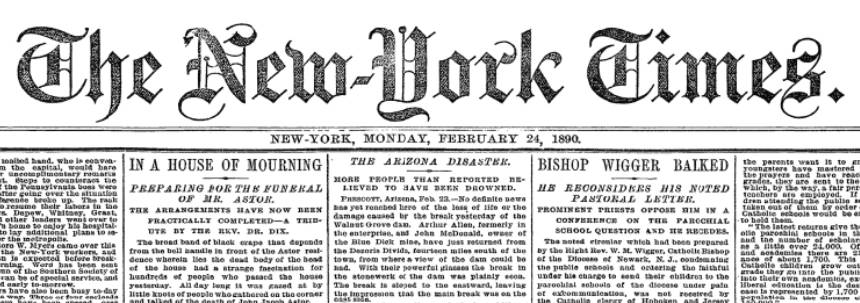
The dead. On March 5, 1890 the Prescott Arizona Weekly Journal-Miner reported that "thirty-nine bodies had been recovered, and ten more persons are known to have been drowned," with "about a dozen" never found. Among them were a party of four men, a woman and two children from Minnehaha, and a teamster drowned with all his horses at Smith's mill. The paper added that "at and near Wickenburg all the ranches were totally destroyed." Later counts grew:
| Source | Toll |
|---|---|
| Journal-Miner, Mar 5, 1890 (contemporary) | 39 bodies + 10 known drowned, about 12 missing |
| Arizona Republic, 1970 | 50 known, "may have exceeded twice that" |
| Town Chamber / Wikipedia | "nearly 70" |
| Arizona Highways, 1946 | 79 bodies |
| Arizona Highways, 1995 | at least 83 bodies |
| Sharlot Hall Museum | 70–100 |
| ASDSO / Arizona Highways (recent) | "over 100" |
Rancher Rufus Cannon recovered 14 bodies himself; his 1944 obituary called it "the experience he remembered most." One 1977 article mentions "dozens of unnamed Chinese laborers" among the dead, but this is unconfirmed. The victims have never been fully named.
Aftermath. - Relief. Yavapai Sheriff William "Buckey" O'Neill, later a Rough Rider, and Maricopa Sheriff William Gray led the search and burials nearly to the Gila. The Vulture lost five miles of its pipeline. - Burke. He was charged with manslaughter but released because territorial law had no provision for negligence, and he vanished. - The lawsuits. Fourteen survivors sued, among them Henry Wickenburg, whose farm lay under feet of rock and sand. At trial in February 1891 the second jury found for the company. The plaintiffs were ordered to pay its legal fees, except Wickenburg. - Van Beuren. He returned to Prescott to a brass band and praise from the territory's chief justice. - Legacy. The dam was never rebuilt, and the Hassayampa remains undammed to this day. A lost company safe is still sought in its sands.
Conflict: Several sources, including Arizona Highways in 1988, date the dam failure to 1891. February 1891 brought a separate regional flood that closed the Hassayampa crossings, and the two events are often conflated.



13. Floods since 1890
| Date | Event |
|---|---|
| Feb 1891 | Regional flood; Hassayampa and Agua Fria impassable for freight |
| Oct 1930 | Rachael Fryman, 30, drowned wading in the Hassayampa while picnicking with her son |
| Sept 5, 1970 | Flood of record: 58,000 cfs. Homes and trailers destroyed, about 50 left homeless, sewer plant flooded; no deaths |
| Sept 1997 | 3,800 cfs |
| Feb 12, 2005 | 19,000 cfs, during Gold Rush Days. A house floated into the US 60 bridge, Kay El Bar was cut off, and parade grand marshal Marshall Trimble was flown out by helicopter |
| Jan 21, 2010 | 26,000 cfs |
| Nov 18, 2025 | Sols Wash flash flood swept a truck and a minivan downstream. Four were rescued, one by an officer on a rope and three by sheriff's helicopter |
14. Fires
| Date | Event |
|---|---|
| 1929 | Fire destroyed half a downtown business block on Frontier Street, followed by a small building boom |
| Feb 10, 1948 | Large hangar at the old WWII airfield burned |
| Dec 21, 1972 | The Desert Caballeros Western Museum, housed in the 1906 Brayton's Commercial Co. building (the town's commercial heart for 60 years), burned with its collection. Volunteers rebuilt it, and it reopened on Frontier Street exactly three years later, Dec 21, 1975 |
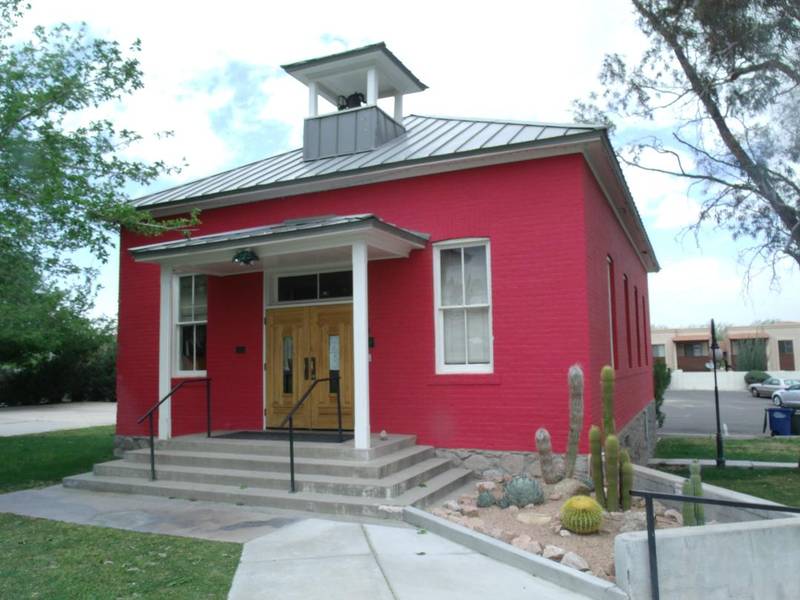
| 1978 | The Garcia "little red schoolhouse" was badly burned; restored 1984 |
| June 12, 2024 | The Rose Fire ran 166 acres along the river south of town, destroying 15 structures including 7 homes, and closed US 60 for 23 hours; no injuries |
15. Railroad wrecks and air crashes
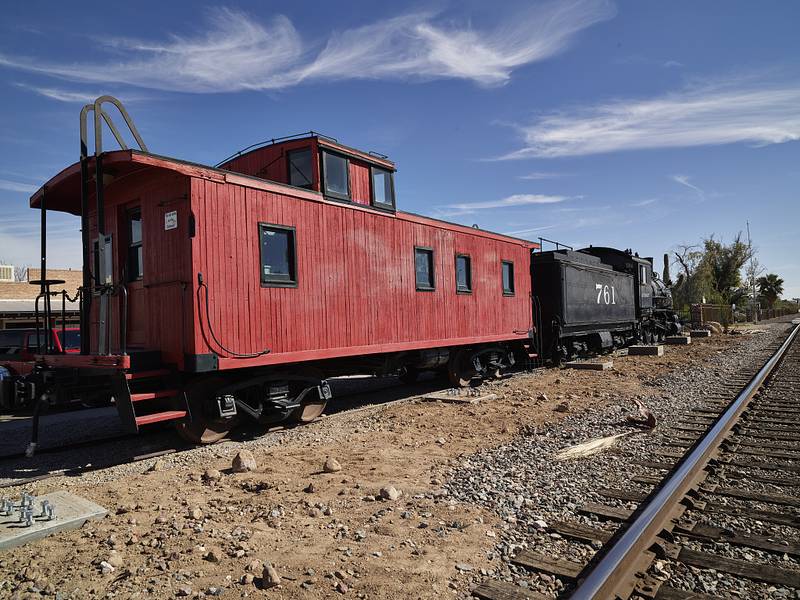
- Rail. In addition to the 1921, 1923 and 1924 wrecks above, the "Peavine" saw an unknown man killed by a train near Vulture siding in 1897. Parker-line passenger trains ended October 1, 1955, and the Santa Fe's daily "Hassayampa Flyer" made its last run in May 1969.
- Air crashes. The open desert and the WWII training fields brought them:
- glider trainee Harry J. Peters (1943)
- Chinese Air Force cadet Sub-Lt. Teh-Shing Foo in a P-51 (Jan 1946)
- USAF F-84 pilots (1953, 1954)
- an F-100F crew of two at the old Echeverria field (1963)
- Tom Wilmeth Sr., when a plane hit a power line on Constellation Road (1976)
- a Cessna 175 with 4 aboard (1979)
- an Aeronca on takeoff (1994)
- glider pilot Robert Knauff at Aguila (2014)
16. World War II
- The glider school. In June–July 1942 the Arizona Gliding Academy opened Wickenburg Field about 15 miles west of town to train Army glider pilots in Taylorcraft TG-6s. In 1943 it became Claiborne Flight Academy's primary school (PT-17 Stearmans), renamed Echeverria Field (the Echeverria name also belongs to a Wickenburg family; the link is unconfirmed). It closed in 1944.
- Desert Training Center. Wickenburg was a rail siding and quartermaster depot for Patton's Desert Training Center, whose divisions camped at Horn and Hyder to the west.
- The gold mines close. On October 8, 1942, War Production Board Limitation Order L-208 declared gold mining non-essential. The Vulture, reopened in 1927, closed; it reopened briefly on a small scale and then shut for good. Popular sources call this "Executive Order 208"; it was a WPB order, not a presidential one.
Part IV: The Modern Town (1900–Present)
17. Building a real town, 1900–1930
The Oro Grande mine sparked a 1901 building boom with new additions to the townsite and lots selling for $100–500. The town also got its first newspaper, the Wickenburg News-Herald, founded by humorist Dick Wick Hall, who legally took "Wickenburg" as his middle name, and his brother Ernest. In 1904 Angela Hutchinson Hammer bought the paper for $500. She later owned six Arizona papers and was posthumously the first woman in the Arizona Newspaper Hall of Fame. J.C. Reed ran the first telephone, with 15 subscribers, from his store in 1902.
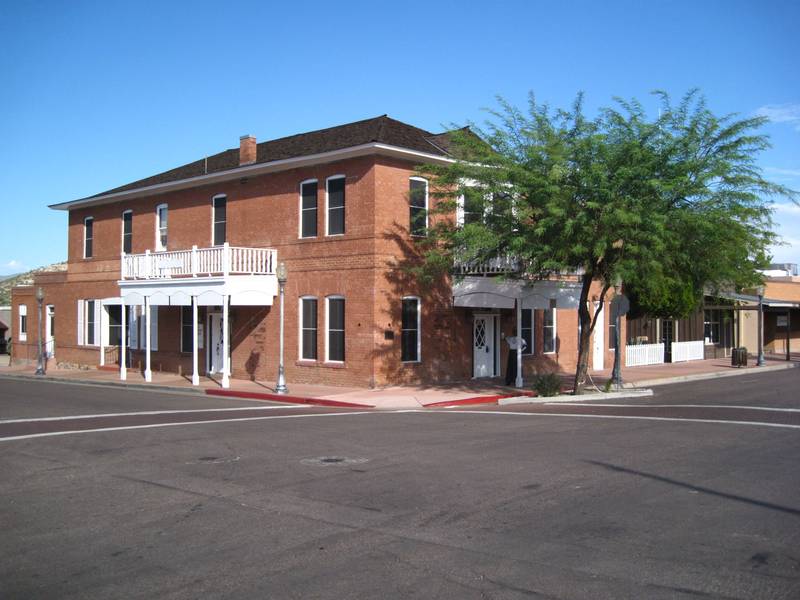
Elizabeth Smith and the Vernetta. In 1905 Elizabeth Smith, a Northwestern University graduate who had arrived in 1897, built the Hotel Vernetta by the depot, designed by territorial architect James Creighton. She was an African American businesswoman. She taught French and was a charter member of the First Presbyterian Church, until, in the words of the 1986 survey, "racial prejudice against Blacks caused her to withdraw." She died in 1935. The building survives at 1 Apache Street.
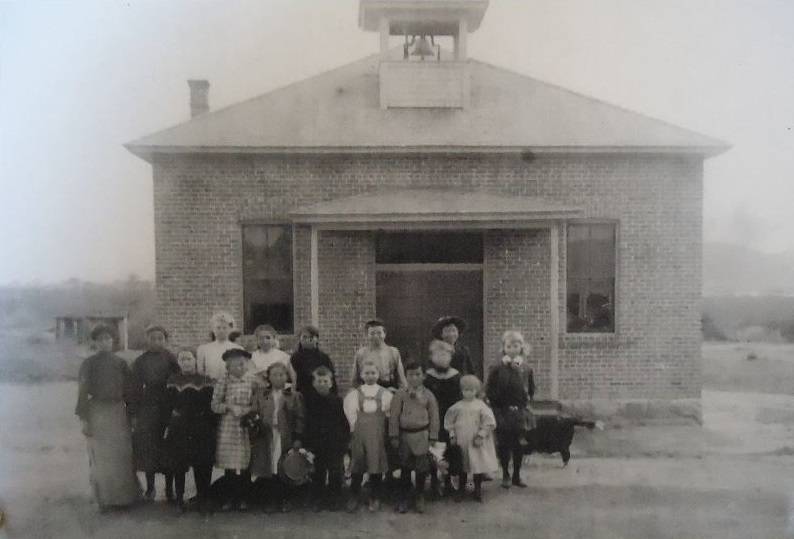
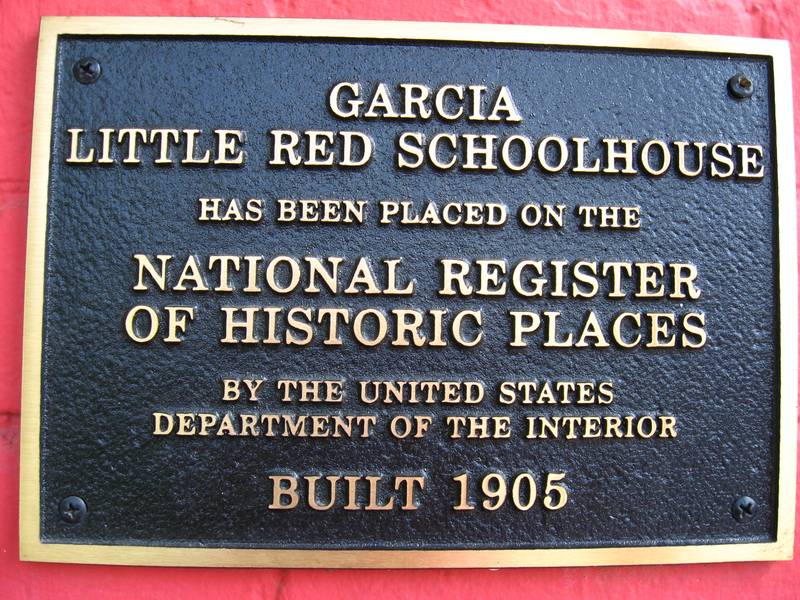
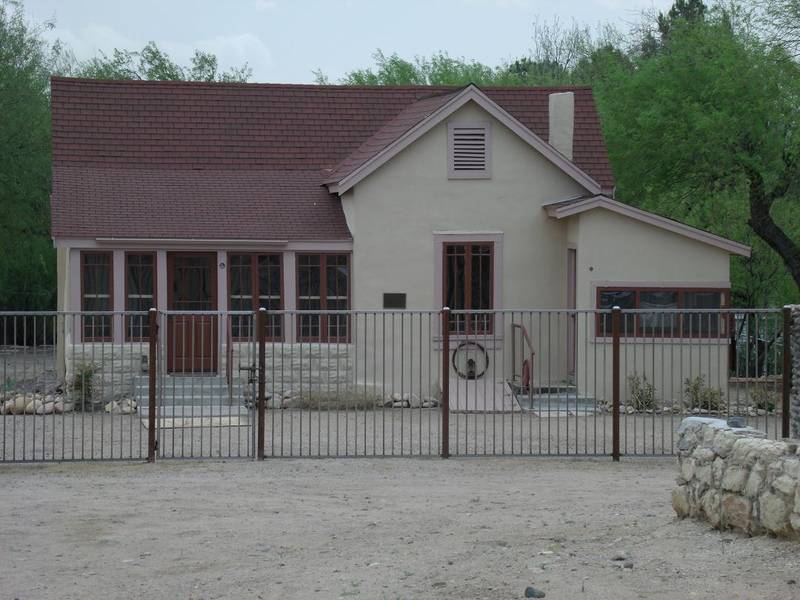
The Garcias. Ygnacio Garcia, born in Mexico in 1837 and in Wickenburg from 1876, is called the "father of Wickenburg education." He gave the land for the brick Garcia School (1905), St. Anthony's Church and the Garcia Cemetery. The red-brick schoolhouse is considered the finest surviving one-room brick school in Arizona. The Orosco, Grijalva, Ocampo, Valencia and Quesada families anchored a Hispanic community that the Chamber says was here before Henry Wickenburg arrived.
Civic milestones. - 1906: the Brayton Commercial Company opened and for 60 years was "a commercial, and to some degree, social center of Wickenburg." - 1909: the town incorporated, with Henry Cowell as first mayor. A 1911 petition to disincorporate failed. - 1914: municipal water works. - 1918: the municipal light plant. Profits from water and power meant the town levied no municipal taxes. - 1923: the town had about 600 people in summer and nearly twice that in winter, with three trains a day to Phoenix. - 1926: Dr. James Copeland opened the first hospital. - 1929: the Frontier Street fire, and the first chain grocery (Safeway Pay'n Takit).
18. The Dude Ranch Capital of the World
A long drought in the 1920s pushed cattlemen to take in paying "dudes."
| Ranch | Founding |
|---|---|
| Garden of Allah (the old Brill ranch) | 1913 |
| Kay El Bar (Romaine Lowdermilk) | informal guests 1916–18, official 1926 |
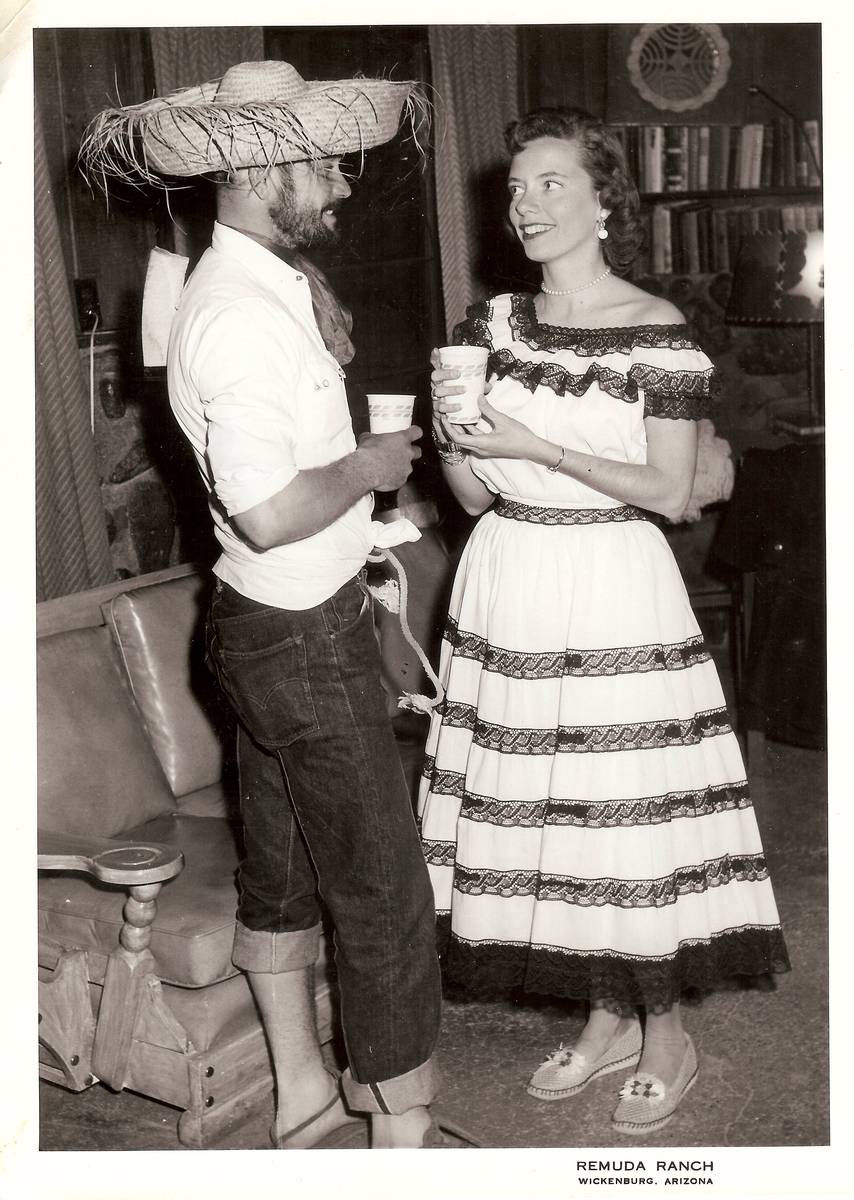
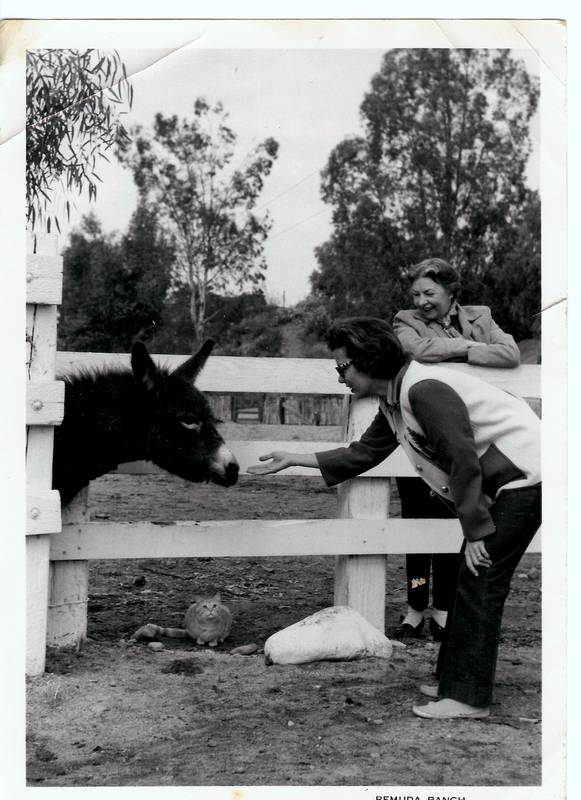
| Remuda (Jack and Sophie Burden, on Henry Wickenburg's old ranch) | 1925–26 |
| Monte Vista (Bob White) | 1926 |
| Bar FX | 1923 or 1929 (Conflict) |
| Flying E (aviation and ride inventor Lee Eyerly) | 1946 |
| Rancho de los Caballeros (Dallas Gant) | 1941 or 1948 (Conflict) |
British novelist J.B. Priestley stayed at Remuda and praised it in Harper's in March 1935. By 1941 the Roundup Club had adopted the slogan "Dude Ranch Capital of the World," and in the 1950s–60s as many as 14 guest ranches operated. In 1988 five remained. Today three historic ranches survive: Flying E, Kay El Bar (NRHP; once home to actor Val Kilmer) and Rancho de los Caballeros.
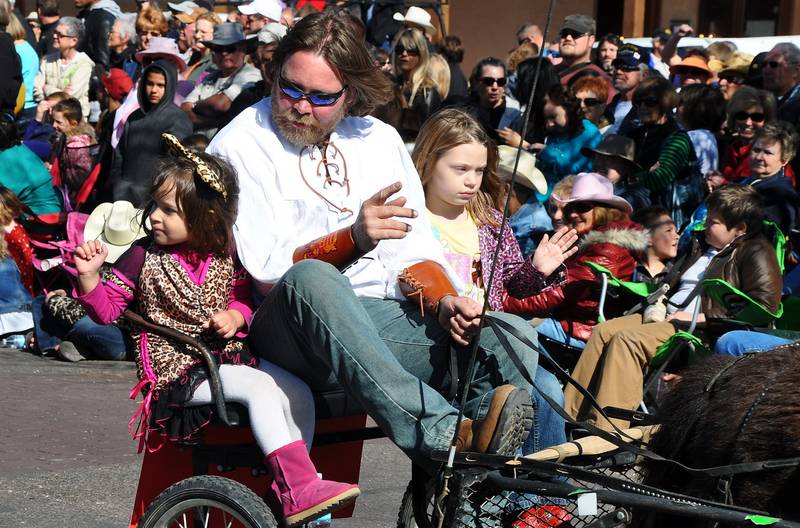
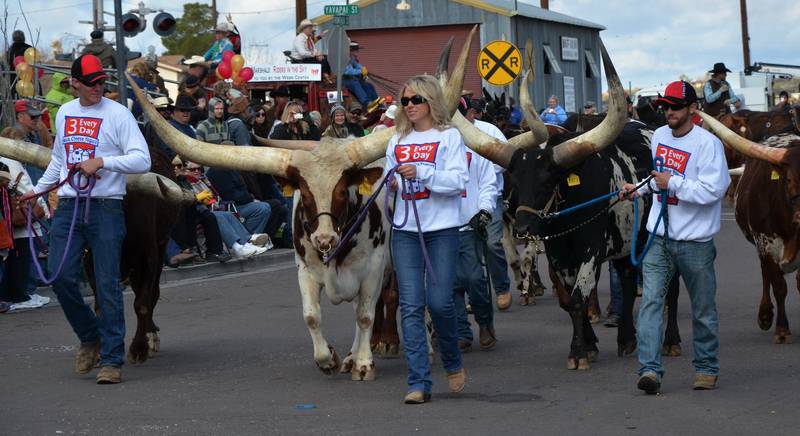
Gold Rush Days, first held in 1948–49, became the town's signature February festival. Its parade is the fourth largest in Arizona, and in 1988 it drew some 30,000 visitors who panned for gold seeded in the riverbed. Rodeo champion Everett Bowman, founder of the Cowboys' Turtle Association (forerunner of the PRCA), became a Wickenburg lawman in 1944. The town's rodeo grounds bear his name, and Wickenburg now bills itself the "Team Roping Capital of the World."
19. Highways, bridges and the bypass
- US 60/70/89. US 89 (1926) and US 60 (extended to California 1930–31) made Wickenburg Way the main road from Phoenix to Los Angeles and Prescott, and the dude-ranch trade followed it.
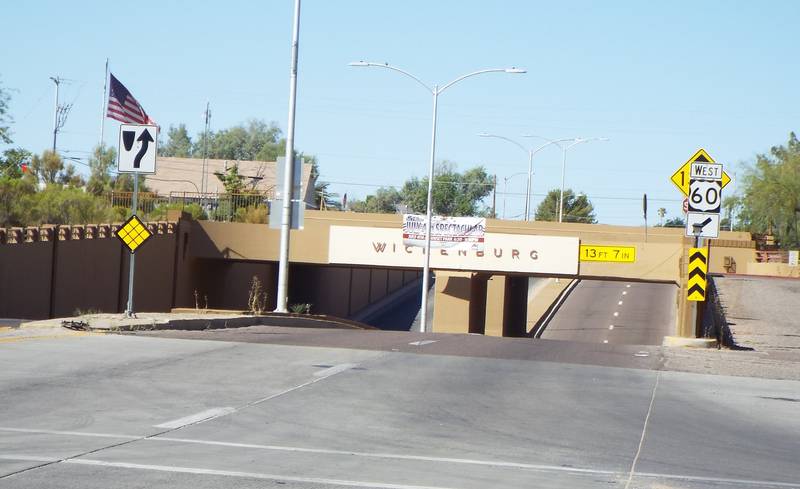
- 1937. The Hassayampa River Bridge and the Center Street railroad underpass opened on April 26, 1937, moving business to Center Street.
- US 93. The direct road to Kingman (SR 93, 1946; US 93 from 1965, into town 1992) made Wickenburg the gateway to Las Vegas. Its two-lane stretches earned their deadly reputation.
- The bypass. In 2009–10 an interim bypass carried US 93 east of downtown, with roundabouts and a new bridge. The 1962 bridge became the pedestrian Hassayampa River Walk, and the 1937 bridge was demolished. More roundabouts and a $55 million widening followed in 2024.
- Interstate 11. Planning for the proposed interstate would end it at Wickenburg.
20. Treatment-center town
Since the 1970s Wickenburg has become, in the words of a 2018 Mic article, "the rehab capital of the US." - The Meadows was founded in 1975–76 by James "Pat" Mellody. Pia Mellody's "Meadows Model" of trauma treatment and Patrick Carnes's sex-addiction program were developed there. Private-equity firm Kohlberg bought it in 2016 for a reported $180 million. Press reports have named celebrity patients. - Remuda Ranch reopened in January 1990 as one of the nation's largest eating-disorder programs, founded by Ward and Kay Keller after their daughter developed anorexia. Rosewood Centers followed. - Wickenburg Community Hospital, owned by the citizens since 1945–46, marks its centennial in 2026.
21. Museum, landmarks and culture
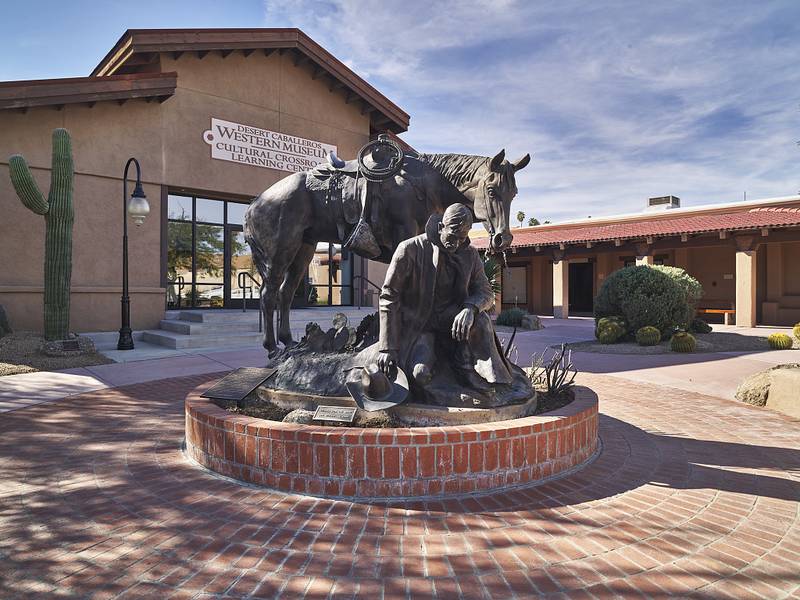
- The museum. The Desert Caballeros Western Museum was founded in 1960 and named for the men's trail ride that began in Wickenburg in 1947. It survived its 1972 fire, was accredited in 1996, and in October 2025 became the Sigler Western Museum after a $20 million gift. A $30 million art-museum expansion broke ground in April 2026.
- National Register. About 25 Wickenburg properties are listed, most on July 10, 1986, among them:
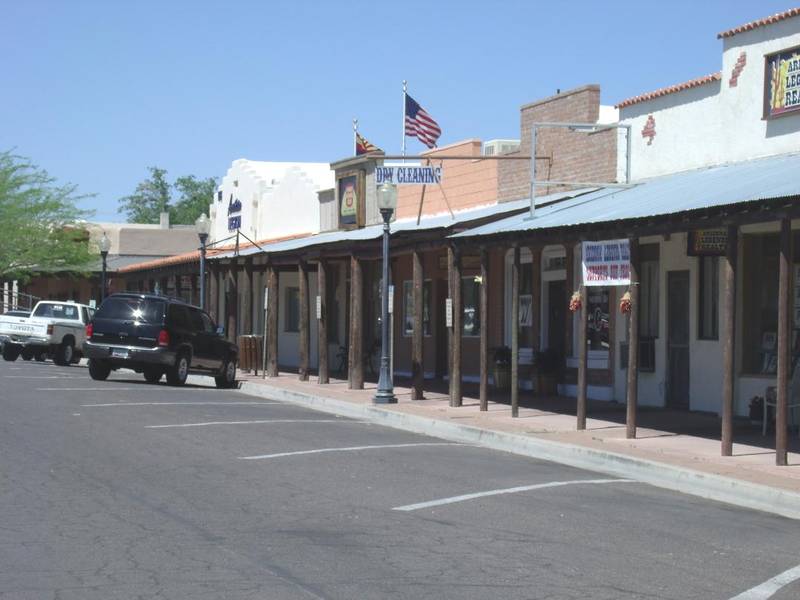
- the Santa Fe depot (now the Chamber)
- the Vernetta Hotel
- the Garcia School
- the 1909 City Hall and Jail
- the 1925 high school and 1934 WPA gymnasium
- the Old Brick Post Office
- the Wickenburg–Boetto House (Henry Wickenburg's last home, 225 S. Washington)
- the Henry Wickenburg Pioneer Cemetery
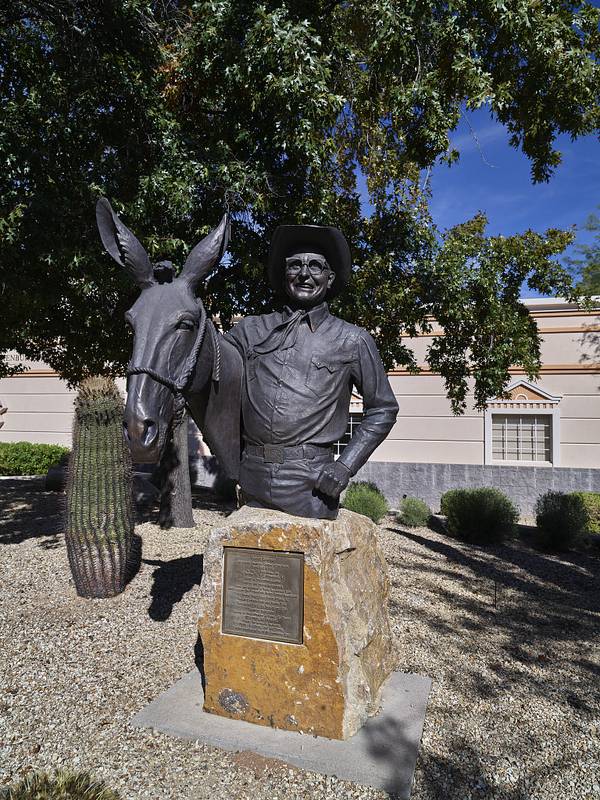
The Masonic Hall (demolished 2011) and the P.J. Thompson House (burned) are gone. - Downtown. Frontier Street has a walking tour of bronze statues, the 1948 Saguaro Theatre, and the 600-seat Del E. Webb Center for the Performing Arts. - Hassayampa River Preserve. The old Brill ranch, stage stop and "Garden of Allah" was bought by The Nature Conservancy in 1986 and is now part of the Vulture Mountains Recreation Area.
Notable residents include: - folk singer Tom Paxton, who discovered folk music here as a teenager - Nobel chemist John H. Northrop, who died here in 1987 - publisher James C. Quayle, father of Vice President Dan Quayle, who owned the Wickenburg Sun from 1977 to 1987 - Interior Secretary James G. Watt - herpetologist Dr. Frederick Shannon, killed by a Mohave rattlesnake in 1965 - humorist Dick Wick Hall
On screen, The Gauntlet (1977, Clint Eastwood) is partly set here, and Vulture City has appeared on Ghost Adventures.
22. Wickenburg today
The town counted 7,474 people in 2020, with a median age of 61.6, and an estimated 8,305 in 2025. Nearly all recent growth is in its Yavapai County annex around the Wickenburg Ranch golf community, begun in 2015. The economy rests on retirees and second homes, behavioral health, the hospital, tourism, team roping and the nearby Bagdad copper mine. BG Bratcher became mayor in December 2024.


Part V: Legends and Conflicts, Quick Reference
| Claim | Verdict |
|---|---|
| Burro/rock or shot-vulture discovery story | Legend. The documented account is a quartz ledge seen on a trek, Oct 1863 |
| Henry Wickenburg was Austrian / born 1830 | False. Baptized in Essen, Prussia, Nov 1819 |
| The Vulture produced $30–200 million | Inflated. About 340,000 oz Au, roughly $7M at historic prices |
| Vulture City had 5,000 people | Unsupported. About 150 workers (1870) |
| 18 men hanged on the Hanging Tree | No record of any hanging |
| Jail Tree used 1863–1890 | Undocumented; the tree may be younger |
| Lost the territorial capital by two votes (1866) | Unverified. Likely a garbled 1864 Walnut Grove vote |
| Glory Hole collapse killed 7–17 (1923) | Unconfirmed. An earlier cave-in had no deaths |
| Henry Wickenburg died July 4, 1905, by an old Colt | Wrong. May 14, 1905, .32 revolver |
| Henry Wickenburg was murdered | Unproven. Inquest ruled suicide; the physical evidence fits |
| Walnut Grove Dam failed in 1891 | Wrong. Feb 22, 1890 |
| Walnut Grove death toll | Uncertain: 49+ contemporary; 70–100+ later |
| Railroad arrived 1895 | Rails Dec 1894; depot 1895 |
| Incorporated June 19 vs Dec 25, 1909 | Conflict between the town and the NRHP |
| Congress train wreck 1934 | Wrong. Mar 7, 1924 |
| Gold mines closed by "Executive Order 208" | Wrong. WPB Limitation Order L-208 |
| First dude ranch | Garden of Allah 1913 / Kay El Bar 1916–26 / Bar FX 1923 or 1929 (Conflict) |
Research Gaps
- Walnut Grove victims are still unnamed. Lists may be in the Journal-Miner of Mar 19 and Apr 9, 1890, and in Dill (1987).
- Crime outcomes after 1930. The Wickenburg Sun is not digitized online. Still unknown: the name of the 1945 Dotson shooter, the 1960 McGee verdict, and the outcomes of the 2004 cases.
- Post office founding date, and the Chinese residents of the Vulture and railroad camps (the 1870 and 1880 census sheets).
- The 1866 capital vote (3rd Legislative Journal) and Henry Wickenburg's own 1868 discovery account (Arizona Miner, June 6, 1868).
- Standard histories not yet consulted: Mark E. Pry, The Town on the Hassayampa (1997); Helen B. Hawkins, A History of Wickenburg to 1875 (1971); Lynn Downey, Wickenburg (Arcadia); R. Michael Wilson, Massacre at Wickenburg (2008); Jim Liggett, Arizona's Worst Disaster (2010).
Principal Sources
- NPS, National Register nomination: Wickenburg Multiple Resource Area (1986) — npgallery.nps.gov/NRHP/GetAsset/NRHP/64000057_text
- Library of Congress, Chronicling America: Weekly Arizona Miner (1868–78), Arizona Citizen, Arizona Republican (1898–1922), Arizona Weekly Journal-Miner (1890–1902), Wickenburg News-Herald (1901–07), Arizona State Miner (1919–27), Bisbee Daily Review (1908–14)
- Arizona Republican, May 15, 1905, "A Pioneer's Death" (via Arizona Gravestones obituary archive)
- Arizona Gravestones obituary archive (transcriptions of the Wickenburg Sun, 1930–2004)
- Gee & Neff, "Walnut Grove Dam Failure" (ASDSO, 2020); Arizona Highways (1942, 1944, 1946, 1977, 1988, 1995, "Dam Shame")
- Sharlot Hall Museum Days Past articles (Wickenburg Massacre, Martin family, Antelope Station, territorial capital)
- HistoryNet ("Ghost Towns: Vulture," "Stage Fright"); Western Mining History ("1880 Vulture Mine Pipeline"); Lynn Downey, The Appendix (2012)
- APCRP field reports (massacre site, Vulture City, Martin cemetery)
- Wickenburg Historical Preservation Society; Town of Wickenburg; Wickenburg Chamber; Sigler Western Museum; Wickenburg Community Hospital
- ICC Bureau of Safety report on the 1924 Congress wreck; Maricopa County FCD stream-gage records; USGS 1970 flood report
- Officer Down Memorial Page; FBI ViCAP; Doe Network; ABC15, Fox10, azfamily, KJZZ news reports
- U.S. Census Bureau (decennial and Vintage 2025 estimates); Gribblenation (highway history); Wikipedia (cross-checked)
Photo Archive
All remaining images collected for this report, oldest first, with credits and licenses.
!["Fred W. Loring, in his campaign costume, with his mule `Evil Merodach.' Taken about 48 hours before he was brutally murdered by Yapavi Indians, while en route from Prescott, A. T. [Ariz. Terr.] to San Bernadino, Cal., by stage. Loring had been with](/history/wickenburg-az/1871-fred-loring-with-mule-evil-merodach-osullivan-commons-800.jpg)






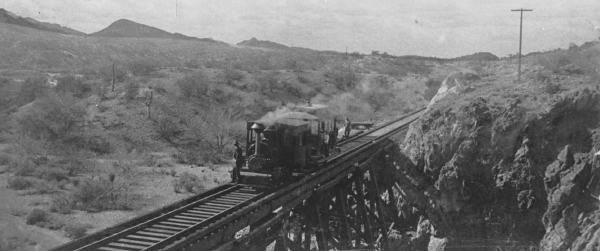

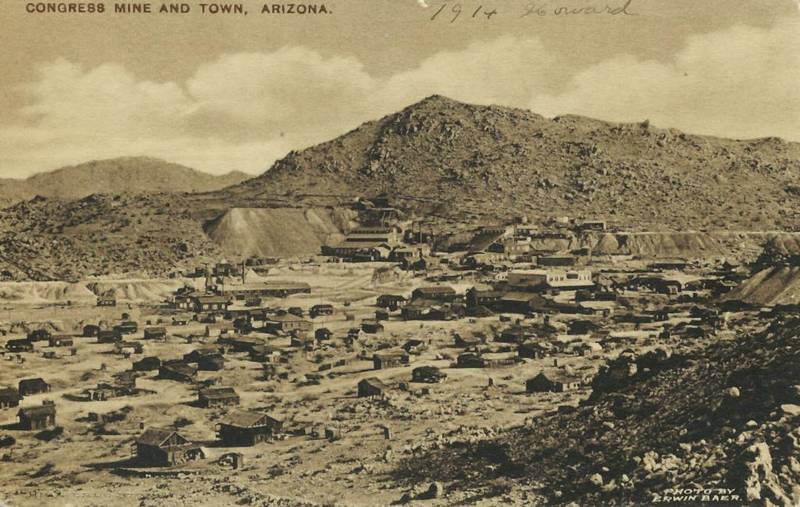
!["On one occasion, [the Congress short-line train] carried residents of Congress to Phoenix for "The Bostonian," a stage play, via the main line."](/history/wickenburg-az/c1905-congress-short-line-excursion-train-commons-800.jpg)


_of_September_25,_1932_-_DPLA_-_3abbc34c365816944eb8de8d79d16c46_(page_1).jpg)
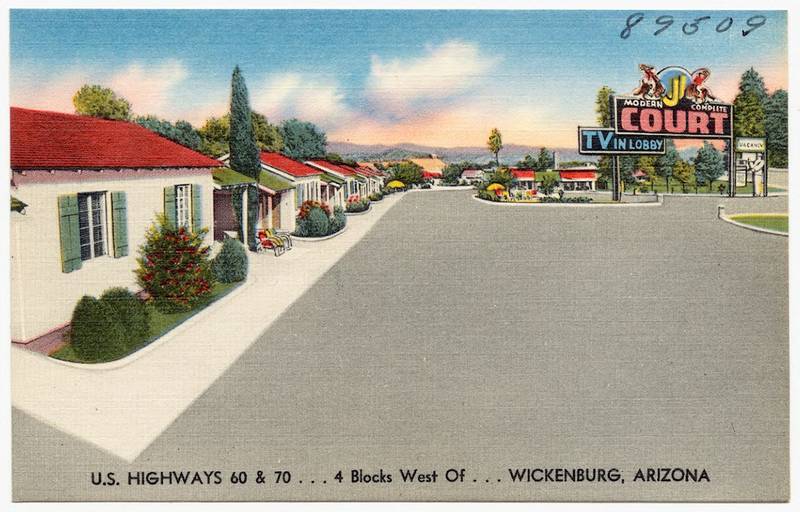
![South Flont [Frontier] Street (House), Wickenburg, Maricopa County, AZ (HABS AZ-54)](/history/wickenburg-az/1940-south-frontier-st-house-habs-az54-delos-smith-loc-800.jpg)
.jpg)
.jpg)
![South Flont [Frontier] Street (House), Wickenburg, Maricopa County, AZ (HABS AZ-53)](/history/wickenburg-az/c1940-south-frontier-st-house-habs-az53-loc-800.jpg)


.jpg)


.jpeg)





























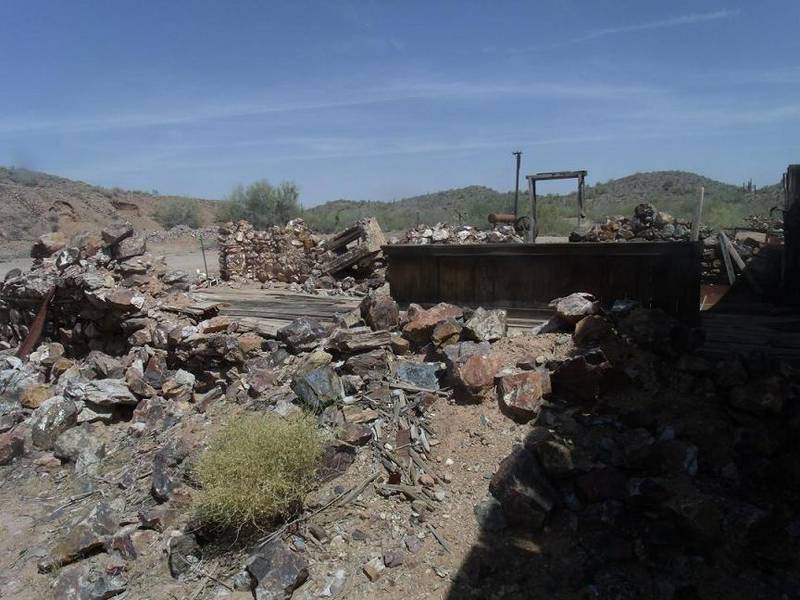

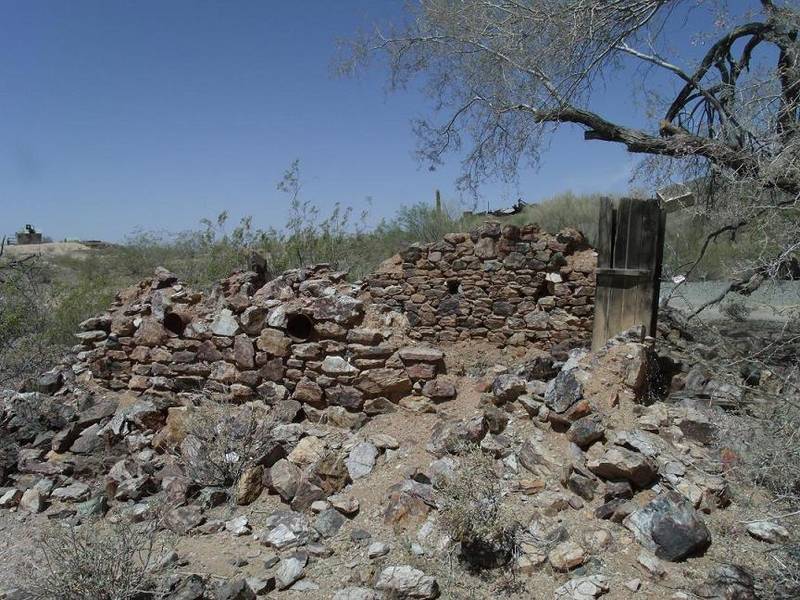

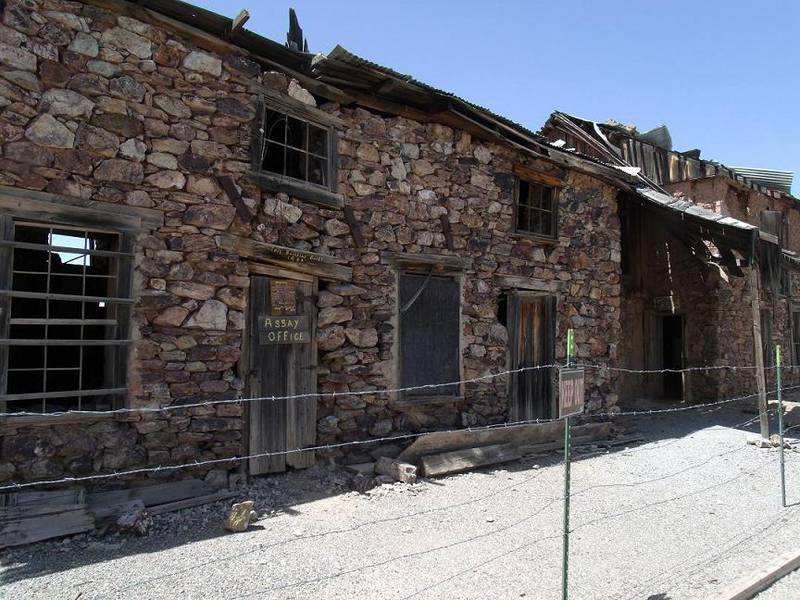

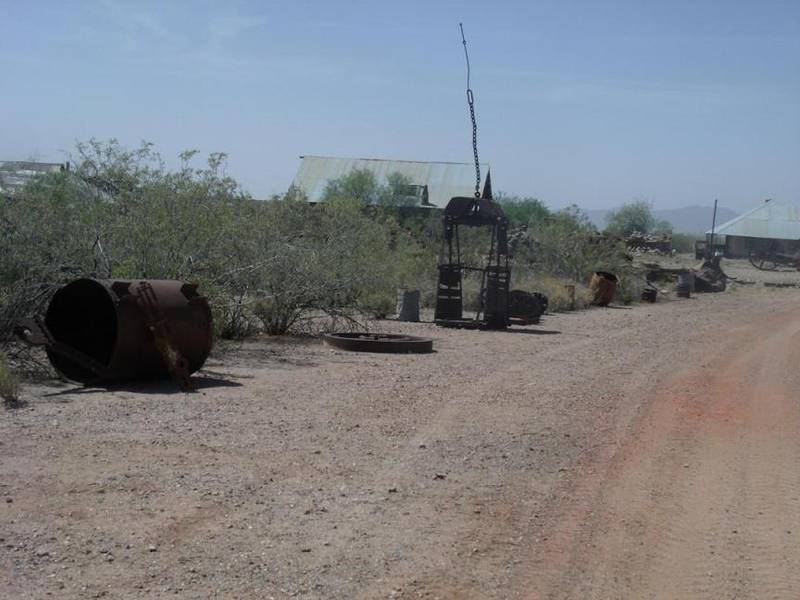
















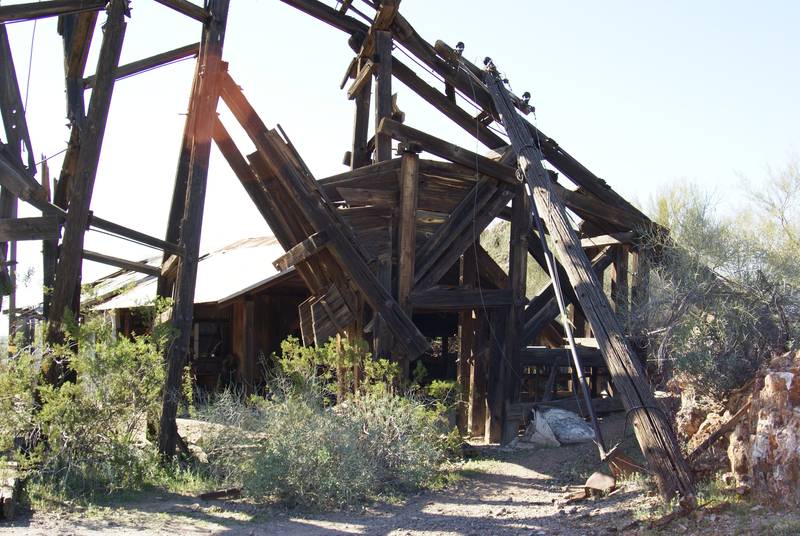

Cover image: The abandoned Vulture Gold Mine by Nancy J. Price (andwhatsnext.com), CC BY-SA 3.0, cropped.